Skip to content
LEGENDS
OF ROMANIA
RO
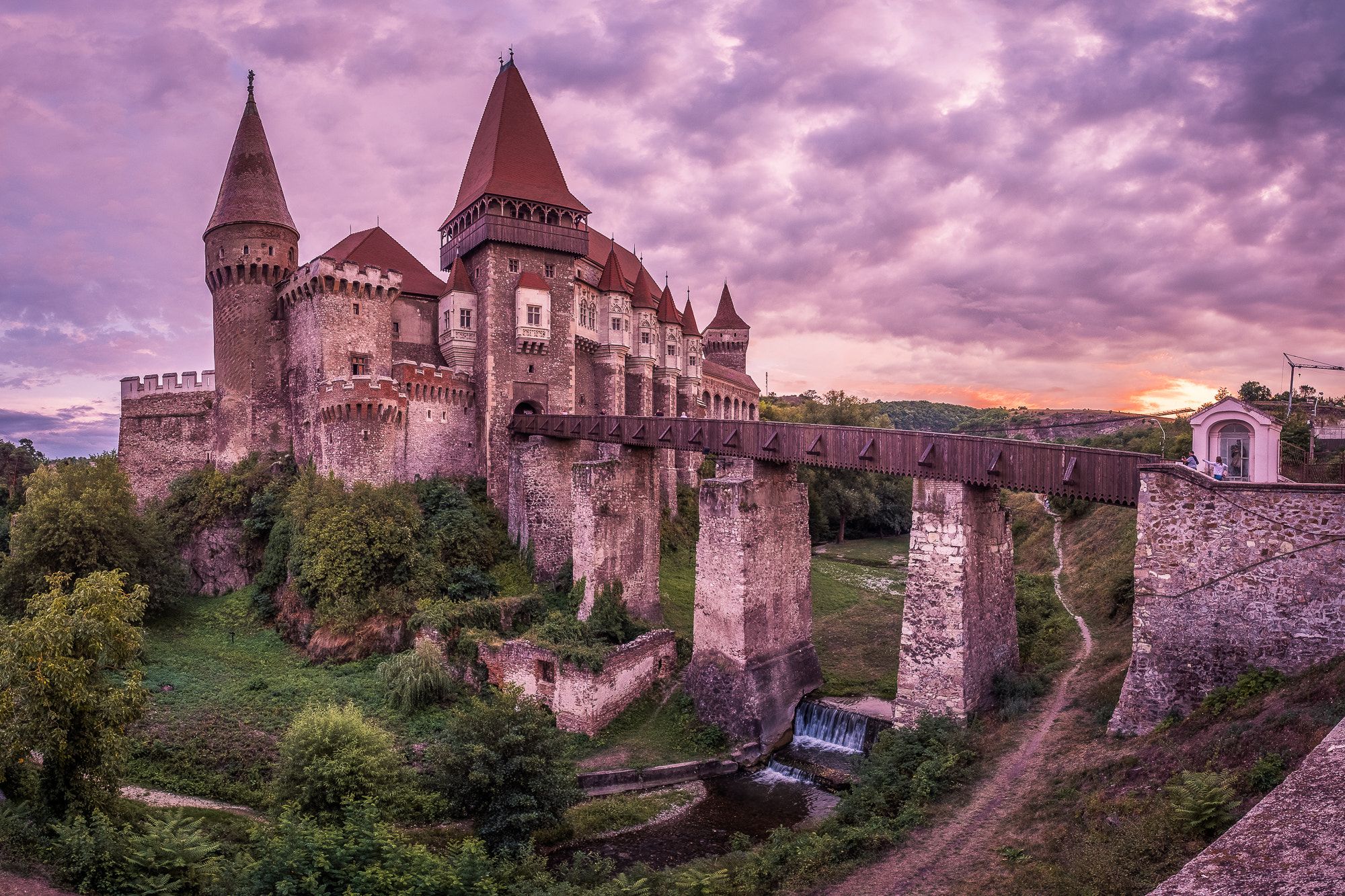
Corvin Castle and its access bridge above the valley beneath sunset-coloured clouds.

Walls

Corvin Castle · Hunedoara / gateway to Hațeg Country

Corvin Castle

A medieval fortification transformed into a residence, museum, and stone palimpsest, where each period left walls, images, and promises interpreted differently.

Photo: Giuseppe Milo · CC BY 3.0 · cropped and optimised for the web

Quick facts and editorial frame

The place at a glance

Real place
Corvin Castle, Hunedoara[12][13]
Type
Medieval castle, historic monument, and municipal museum[12][13][9]
Location
1–3 Strada Castelului, Hunedoara

Other official records use the address variants Curtea Corvinilor or Curtea Corvineștilor no. 1–3.

[9][12]
Heritage records
LMI HD-II-m-A-03344; RAN 86829.02[13][12]
Chronology
Disputed medieval core; major transformations in the fifteenth, seventeenth, and nineteenth centuries[1][12][4]
Access
Ticketed museum; historic route with stairs and elevated passages[6][11]
Duration
Variable; no standard visit duration was found in the official information checked[6]
Before visiting
Check opening hours, available rooms, and the accessible route on the day of your visit[6][10]

Featured legend

The Witness in the Well

Three fictional testimonies about a well cut into rock, a promise of freedom, and a debt the successor refuses to inherit.

Year One — The One Who Counts

On the day of the promise, the courtyard smelt of slaked lime and wet timber. A new wall was rising beside the old one, and between them lay an opening in the rock, wide enough for three men with pickaxes.

The lord of the castle watched us from beside the stairs. The man next to me later said the sun had flashed on a piece of metal fastened to his cap. I remember things that can be checked: three steps down to the courtyard, two guards on the left, the clerk with his wax tablet on the right.

He asked whether we knew how to dig. The One Who Remembers answered that any man could learn, if he were shown where. The One Who No Longer Believes said nothing. I asked how deep.

The lord laughed.

‘When the three of you draw water from this rock, you will pass together and free through the gate by which you entered, and my house will not stop you.’

The guards and the clerk heard him. I asked for it to be written down.

‘Write that they have been ordered to dig a well,’ the lord said.

‘And our freedom?’

The clerk did not look up. The lord was already descending the steps.

That evening, I scratched one line into the pickaxe handle for each part of the promise: when; the three of you; water; together; free; the gate; my house will not stop you. Seven marks.

Clerk’s Note — Start of the Work

Three captives have been set to digging a well between the walls. They have received three pickaxes, two sledgehammers, one chisel, one bucket, and two ropes.

Ration: bread, onion, and water, twice each day.

The captives maintain that they were promised release. No written order exists.

At the First Support Beam — The One Who Remembers

The One Who Counts says the lord said ‘the three of you’. I heard ‘if you draw water’. The One Who No Longer Believes says that a cart was crossing the bridge and its wheels drowned out the end.

At first, the differences seemed small. Every version still meant freedom.

I kept the things from outside. In the morning, I said the name of my village, the street, and the two hills between which our house could be seen. At noon, I recited the ingredients of the soup my sister made when the cold arrived: lentils, onion, thyme, salt, and vinegar at the end. In the evening, I said the prayer my mother had taught me, then the names of the dead, so that distance would not erase them.

The others listened. After a while, The One Who No Longer Believes began changing an ingredient to test me.

‘You said garlic, not thyme.’

‘I said thyme.’

Then I would begin again.

In the shaft, the light faded before the day was over. We raised stones in the bucket and heard the rope rub against the beam. The rock returned the sounds of iron, coughing, and breath. Voices went out clearly and came back altered, as though someone else went on speaking after we fell silent.

One evening, I said my sister’s name. The echo returned only the last syllable. I repeated it, and something else came from beneath us:

‘The gate.’

The One Who Counts said the bucket had struck the wall. The One Who No Longer Believes said I had fallen asleep on my feet. Neither asked me to say the name a third time.

Clerk’s Entry — After the First Rope Broke

The old rope broke beneath a load of stone. No man was injured.

The captives request a new rope, two lamps, and the entry of the promise in the ledger. The first request is justified. The second depends on the supply of tallow. The third does not concern the work.

The guards report words heard after the blows have ceased. The echo between the walls is strong.

Year Five — The One Who No Longer Believes

That was what The One Who Counts called me. On the wall he kept the days, the loads of stone, and the missing rations; the seven marks on the pickaxe were a separate reckoning. I counted differently: two guards had died, three had been moved elsewhere, and the boy who lowered our lamps had grown a beard.

I told the others:

‘If we find water, they will say there is not enough. If there is enough, they will say the lord was joking.’

The One Who Counts touched the seven cuts. The One Who Remembers stared at the ground and repeated his list of names, leaving gaps between them.

I wanted the next loaf and the next breath after every cloud of white dust. The gate could wait.

That year, the sledgehammer began to set up a long vibration in the rock. One day, I was working below on my own. I struck three times and heard it clearly:

‘You will pass.’

I stood with the hammer raised. The words might have meant the gate or merely that day. When the others came down, I said nothing. The One Who Counts would have added a rule. The One Who Remembers would have given the voice a name. I needed it to be a trick of the ear.

Clerk’s Note — On the Words Heard

The first captive states that the shaft repeats ‘the three of you’.

The second states that the shaft repeats ‘the gate’.

The third states that he hears no words.

One guard states that he heard ‘free’, then withdraws his statement after punishment. The work is to continue and discussion is to cease.

At the Depth Where the Circle of Light Had Shrunk to a Coin — The One Who Counts

When the first pickaxe handle broke, I moved the seven marks to the eastern wall, above a white seam in the rock. Beside them I cut marks for the working days, the loads raised, and the rations that had not come. I could not measure the depth, but I could prove its cost.

One morning, the bucket descended without bread. The guard told us that the lord of the castle had died far away and black cloth was being hung in the courtyard.

I asked to speak to the clerk. He came three days later and remained at the edge.

‘His house inherited the well,’ I said. ‘It inherited the walls and the water we have not yet found. It inherited the debt as well.’

‘There is no debt in the ledger.’

‘You were there. You heard.’

A trickle of sand fell from above and scattered over my shoulder.

‘Hearing is not proof,’ the clerk said.

A whisper came from the damp rock beneath our feet: ‘My house.’

The clerk drew back from the edge.

‘Did you hear it?’ I shouted.

He did not answer. The circle of light remained empty.

After the Death of the One Who Promised — The One Who Remembers

The new lord heard us from the balcony. The drop, the balustrade, and the clerk holding the ledger against his chest stood between us.

The One Who Counts recited every part of the promise. I said that we would leave together through the gate by which we had entered. The One Who No Longer Believes maintained that he had not been listening.

‘Three testimonies, three promises,’ the successor said. ‘I do not inherit a debt that even you cannot name in the same words.’

‘But you inherited the well,’ The One Who Counts replied.

A guard struck him across the mouth with the back of his hand. There was blood on his chin.

We were questioned separately. The clerk wanted to know which word came before ‘free’ and which followed ‘gate’. I remembered my mother’s name, the smell of the soup, and the entire prayer. The word after ‘gate’ would not come.

The clerk closed the ledger.

‘If you cannot remember, I cannot write it.’

‘Write that I cannot remember.’

When they lowered us again, I told the others I had forgotten. The One Who Counts pressed his forehead to the wall. The One Who No Longer Believes gave me half his onion.

From that day, they asked me to tell them their names every evening.

Record — The Three Statements

First: ‘When the three of you draw water from this rock, you will pass together and free through the gate by which you entered, and my house will not stop you.’

Second: ‘When you find water, you will leave together through the gate by which you entered.’

Third: ‘If there is water, he will let us leave.’

The statements are not identical. The successor does not recognise the obligation.

The work will continue because the castle requires water.

On the Night the Gate Stood Open — The One Who No Longer Believes

A storehouse collapsed before the rain, and everyone in the courtyard was called to move sacks and beams. We were brought out of the shaft to unload stone. The guards were few and hurried.

At dusk, I saw a cart loaded with empty sacks setting off towards the gate. The cloth at the back hung almost to the ground. Between the wheel and the wall was space for a thin man.

I followed the cart with a length of rope over my shoulder, as though someone had sent me. Ten paces from the gate, I could feel the air beyond it.

The clerk came out of the chancery with the ledger beneath his arm. He saw me but did not call out. He showed me the page with our statements.

I could have reached the cloth before the bar fell. The others would have been left with two different testimonies, while I would have been a fugitive.

I stopped.

‘Did you not hear the promise?’ he asked.

‘I heard it.’

‘Then why did you say you had not?’

The cart was passing beneath the gate. Its left wheel creaked.

‘I remembered when I reached this place.’

I turned back towards the shaft. Behind me, the gate closed.

Clerk’s Note — Before Water

The third captive had an opportunity to escape and did not do so.

He has completed his statement: the promise concerned all three; they were to pass through together; the dead man’s house was not to stop them.

The rock at the bottom of the shaft is damp. The work continues with guards working in two shifts.

On the Day of Water — The One Who Counts

We knew before we saw it. The chisels came out cold, and dust clung to them like flour to fingers. We took turns striking.

At the ninth blow, a black line appeared in the fissure. At the tenth, the line shone. I touched it with one finger and tasted it.

Water.

It gathered slowly in a hollow, cloudy with dust. The One Who Remembers washed his lips. The One Who No Longer Believes filled his cupped palm.

I pulled the rope. Above, someone rang the small bell. The guards, the master builder, the clerk, and the new lord came. The bucket descended, struck the water, and filled halfway.

‘The water is here,’ the successor said. ‘Your statements remain three.’

The bucket rose. Drops fell over us. One struck the wall beside the first of the seven marks.

The shaft said, ‘When.’

A second struck the bucket’s iron band.

‘The three of you.’

Then the words came one after another, carried by drops and returned by the walls, the rope, and the beam. Not loudly: only enough for those above to fall silent.

‘You will draw water from this rock. You will pass together and free through the gate by which you entered.’

The clerk dropped the ledger beside the edge.

The final part came in the dead man’s voice. Or in the voice we remembered. Or in all our voices, layered for one moment in the same echo.

‘And my house will not stop you.’

After that, there were only the drops and our breathing.

Final Testimony — The One Who Remembers

They brought us into the light after sunset. The water had been poured into a copper vessel. The new lord asked what each person had heard.

The master builder said it had been the echo. One guard said he had heard a voice, another that the rope had spoken. The third looked at the ground.

The clerk knelt beside the vessel and touched the water with two fingers.

‘I heard the whole sentence.’

‘You heard only what their testimonies had led you to write,’ the successor replied.

The clerk opened the ledger. Beneath the three different versions, in fresher ink, stood the entire sentence. I do not know whether he had written it before the water, from our fragments, or after he heard it. His hand shook so badly that I did not ask.

The One Who Counts had dried blood at his mouth. The One Who No Longer Believes watched the gate. I searched for my sister’s name and could not find it.

Then the one who said he no longer believed whispered it to me.

Unfinished Entry — The Clerk

Water has been found in the well between the walls.

The dead man’s promise was heard by the three captives, three guards, the master builder, and the undersigned. Testimony concerning the voice differs. The words are recorded exactly:

‘When the three of you draw water from this rock, you will pass together and free through the gate by which you entered, and my house will not stop you.’

The well remains for the use of the castle.

Regarding the three men and the fulfilment of the obligation, the ruling is:

[The line for the ruling was left blank.]

Documented folklore

Reported local legends

These stories are traditions or accounts associated with the place, not confirmed historical facts and not the original fiction published by Legends of Romania.

01 · Reported

The Well of the Three Prisoners

Official visitor tradition says that John Hunyadi promised three Ottoman prisoners their freedom if they found water. They supposedly dug approximately 28 metres through rock for fifteen years. John allegedly died in the meantime, and Elizabeth Szilágyi refused to release them and ordered their deaths.

An interwar account used sixteen years. The popular phrases ‘You have water, but no heart’ and ‘You have water, but no soul’ do not match Mihail Guboglu’s reading, which identifies Hassan as a prisoner in the fortress by the church.

The well and inscription are real; the number of prisoners, fifteen years, promise, execution, and Elizabeth’s role belong to visitor tradition rather than confirmed medieval history.

[5][3][20]

02 · Reported

The Raven and the Golden Ring

The official legend presents John Hunyadi as the illegitimate son of King Sigismund of Luxembourg and Elizabeth of Hațeg. A ring intended to identify the child is stolen by a raven and recovered after the bird is shot; the king then supposedly adopted the raven holding a ring as the family emblem.

Versions differ even over who shoots the raven: the young John or a member of his mother’s family.

The raven and ring in Hunyadi heraldry are real; royal paternity is not historically established. Academic research treats the tradition in the context of dynastic legitimacy and propaganda.

[5][17][18]

03 · Traditional

The Fairies Who Raised Three Fortresses

A poem reproduced by the museum says that three fairies built fortresses at Hunedoara, Grădiște, and Orlea. Hunedoara’s fairy modestly promises to finish within a week if God helps her, and her fortress survives. The other two throw a huge mass of iron after her, cutting the mountain and explaining the name Retezat.

The poem must not be reduced to a factual claim that fairies built Corvin Castle or automatically merged with versions involving a giant’s daughters.

The museum cites Jacob Radu’s 1913 work. This demonstrates printed circulation by that date, not the tradition’s oral age or an identified informant.

[5][19]

The real place

What is true here

The castle preserves several histories at once: a core of disputed date, John Hunyadi’s residence, alterations associated with Matthias and Gabriel Bethlen, an Ottoman inscription, and the marks of restorers who changed the monument’s silhouette.

01

History

No consensus

A core of disputed date

Most researchers date the first stone fortification to the fourteenth century, while other specialists propose the first half of the fifteenth. No single ‘foundation date’ safely summarises the evidence.

[1][12][15]

02

History

Source-based estimate

From the 1409 grant to the post-1440 castle

The act of 18 October 1409 granted the royal possession of Hunedoara to Voicu and his family and named his son John. After approximately 1440, John Hunyadi transformed the existing fortification with walls, towers, and increasingly ambitious residential spaces.

[2][1][3]

03

History

Well documented

1452, Written in stone

A Gothic-lettered Latin inscription on the second column capital in the Knights’ Hall says that John Hunyadi, governor of the Kingdom of Hungary, caused ‘this work’ to be made in 1452. It does not automatically date the entire palace.

[3]

05

Culture

Source-based estimate

The Matia Wing, between attribution and analysis

Work on the northern wing is placed probably after 1458, while the loggia fresco belongs to the second half of the fifteenth century. Modern analysis can identify the painting materials and deterioration, but does not by itself establish the patron of every intervention.

[1][3][16]

06

History

Source-based estimate

Bethlen adapted the castle to another age

Between approximately 1618 and 1624, Gabriel Bethlen remodelled residential spaces and added structures adapted to heavy firearms, including the White Tower and Artillery Terrace. The castle visible today does not belong to a single period.

[1][12][14]

07

Unexpected fact

Well documented

The roofs are not solely medieval

After the 1854 fire, restoration begun in 1868 dismantled, reconstructed, standardised, and heightened parts of the monument. An important part of today’s silhouette and roofscape derives from nineteenth-century restoration choices.

[4][9][15]

08

Culture

Source-based estimate

A real inscription, a different message

An Ottoman or Turkish inscription in Arabic characters stands on a chapel buttress and is dated approximately to the mid-fifteenth century. Mihail Guboglu read it as identifying Hassan, a prisoner ‘among the giaours’ in the fortress by the church — not the popular reproach ‘You have water, but no heart.’

[5][3][20]

At a glance

Reference facts

Place identity

Operator
Muzeul Castelul Corvinilor, a municipal museum[9][11]
Status
Group-A listed historic monument[13][12]
Setting
On a rocky spur in south-western Hunedoara, near the Cerna and Zlaști waterways[12][7]
Orientation point
Approx. 45.7491, 22.8883; the coordinates mark the attraction, not parking[8][12]

Chronology

Early fortification
Most often dated to the fourteenth century; some specialists propose the first half of the fifteenth century[1][12][15]
Royal grant
18 October 1409: the royal possession of Hunedoara is granted to Voicu and his family; the document also names John[2]
Hunyadi transformation
Large-scale work after approximately 1440, adding walls, towers, and residential spaces[1][3][14]
Bethlen phase
Approx. 1618–1624, depending on the source[1][12][14]
Historic restoration
Begun in 1868 after the catastrophic fire of 1854; the interventions changed part of the present silhouette[4][9][15]

Architecture

Great Palace
Knights’ Hall, Diet Hall, and spiral staircase[1][3]
Knights’ Hall
Two aisles divided by five octagonal marble columns; Latin inscription dated 1452[1][3]
Nje Boisia
Five-level defensive tower linked by an elevated gallery more than 33 m long[1]
Matia Loggia
Wing and secular painting cautiously attributed to the second half of the fifteenth century[1][3][16]
Well
Approx. 28–30 m deep, cut between the old and new enclosures[1][3][5]

Visiting notes

Verified schedule
1 October 2026–31 March 2027: Monday 12:00–17:00; Tuesday–Sunday 09:00–17:00The page does not publish a last-admission time; check the schedule on the day of your visit.[6]
Integrated ticket
Castle, Guild House, and archaeology/prehistory exhibition; individual room availability can vary[6][9][11]
Stairs and heights
The historic route includes stairs, balconies, and elevated galleries; do not lean over parapets and avoid crowding[6]
Pets
Pets are not permitted; no published assistance-animal policy was found[6]

Visiting guide

Practical notes

Accessibility
Urban access; historic interior routeThe castle is a ticketed museum at 1–3 Strada Castelului. The coordinates mark the attraction, not parking; no official parking or drop-off point was verified. The interior route includes stairs and elevated passages, and room availability can vary during works.
Time & Season
Variable; no standard visit duration was found in the official information checked · Open on a seasonal schedule; check official hours on the day of your visitIdeal time: During official hours, allowing enough time before closing; last admission is not published separately
01

Getting there

The museum publishes the address as 1–3 Strada Castelului, Hunedoara 331141; other records use 1–3 Curtea Corvinilor or Curtea Corvineștilor. The map point marks the monument, not parking. Use the official location page for orientation and verify parking or drop-off locally.

02

When to go

When checked on 30 October 2026, the museum published hours for 1 October 2026–31 March 2027 of Monday 12:00–17:00 and Tuesday–Sunday 09:00–17:00. Last admission is not published separately. Check the official page before travelling for changes or holiday exceptions.

03

Is it suitable for children?

Yes, with continuous supervision. The operator warns about stairs, access routes, and elevated areas and says that children must not be left unattended. Avoid crowding on balconies, stairs, and galleries.

04

Keep in mind

Available rooms can change during restoration work. Pets are not permitted, and no assistance-animal policy was found in the published sources. For reduced mobility, contact the museum before travelling and ask about the currently accessible route.

05

Tickets and photography

The official page offers online purchase through an intermediary and publishes separate photography, filming, and guide fees. Check current charges before visiting. Paying a photography fee does not automatically grant permission for commercial publication.

06

Works and available rooms

No closure applying on 3 September 2026 was found, but neither was a final completion notice for every Stage 2 intervention. Confirm room availability with the museum if travelling a long distance.

Before you go

Safety is part of the journey.

Do not lean over parapets and avoid crowding on balconies, stairs, and elevated galleries. Visitors with reduced mobility should contact the museum about the currently accessible route; free admission does not establish physical accessibility.

Practical information checked 30 October 2026

  • On the day of your visit, check opening information, closures, and rules in the official resources.
  • Use only areas open to visitors and respect barriers, signs, and instructions from staff or the community responsible for the place.
  • Take care on steps and uneven or slippery surfaces, and supervise children.
  • Keep your phone charged and adapt the visit to the weather and the conditions you find on arrival.

Official resources and updates

In an emergency, call 112 and describe the location and situation as clearly as possible.

Field detail

Notice this

Compare the medieval walls with the restored roofs and heightened sections: today’s silhouette preserves both the castle and nineteenth-century ideas about how it ought to look.

Location

Where it is

The pin shows the attraction location for orientation. It is not automatically a car park, trailhead, or proof of vehicle access.

Documentation

References

Numbers in the text point to the list below. Titles open the external source used for verification.

  1. [1]Scurtă istorie — Muzeul Castelul Corvinilor
  2. [2]Mențiuni documentare — Muzeul Castelul Corvinilor
  3. [3]Turul castelului — Muzeul Castelul Corvinilor
  4. [4]Restaurarea castelului — Muzeul Castelul Corvinilor
  5. [5]Legendele castelului — Muzeul Castelul Corvinilor
  6. [6]Program si tarife — Muzeul Castelul Corvinilor
  7. [7]Localizarea castelului — Muzeul Castelul Corvinilor
  8. [8]Corvin Castle (Q126576) — Wikidata / Wikimedia Foundation
  9. [9]Muzeul Castelul Corvinilor — Municipiul Hunedoara
  10. [10]Restaurarea și valorificarea durabilă a patrimoniului cultural — Ansamblul arhitectural Castelul Corvinilor — etapa 2 — Municipiul Hunedoara
  11. [11]HCL nr. 376/2025 privind stabilirea taxelor la Muzeul Castelul Corvinilor Hunedoara pe anul 2026 — Consiliul Local Hunedoara
  12. [12]Castelul Corvineștilor — Hunedoara, cod RAN 86829.02 — Repertoriul Arheologic Național / Institutul Național al Patrimoniului
  13. [13]Lista Monumentelor Istorice 2015 — Județul Hunedoara — Ministerul Culturii / Institutul Național al Patrimoniului
  14. [14]Muzeul Castelul Corvinilor — CIMEC / Institutul Național al Patrimoniului
  15. [15]Ground Penetrating Radar Investigation of Corvin Castle (Castelul Corvinilor), Hunedoara, Romania — Heritage
  16. [16]Archaeometric studies of mural paints from Matia Loggia (Corvins’ Castle) — Romanian Reports in Physics
  17. [17]John Hunyadi in Hungarian Folklore and Historiography — Acta Universitatis Sapientiae, Philologica
  18. [18]Mythos als Propaganda — Acta Antiqua Academiae Scientiarum Hungaricae
  19. [19]Istoria vicariatului greco-catolic al Hațegului — Jacob Radu / Biblioteca Națională Széchényi
  20. [20]Cât adevăr este în legendele înfiorătoare despre Castelul Corvinilor. Semnificația reală a unei inscripții misterioase — Adevărul