Featured legend
The Fortress in the Mist
A legend about an old fortress, people caught between two worlds, and the way stone keeps gestures that history forgets.
That year, summer had withdrawn slowly from the mountains. The beech leaves had yellowed at the edges, and the grass in the high clearings stayed wet until nearly noon. The mornings brought thick mist up from the valleys, hiding the old walls of Bálványos Fortress now halfway, now completely.
The road to the top was no longer a true road. Once it had been worn by footsteps, hooves, and small carts loaded with salt, hides, and sacks of grain. Now it disappeared among roots, broke off near the springs, and appeared again higher up beneath rotten leaves.
Márton knew how to keep silent. He had grown up with it.
His mother had been baptized in the church below, the new one, with white walls and a fresh shingle roof. His father had died before the priest had time to place a cross at his head, and the old people still whispered that the body had been buried according to the old custom, facing east, but not toward the altar, toward the place where the forest opened. Márton had never asked what that meant. In their house, some questions were heavier than the answers.
When Father Benedek sent him to the fortress, he did not give him an order. He only placed his hand on Márton’s shoulder and said:
“They will listen to you more readily.”
Márton did not know if that was true. Perhaps because he still knew the old names of certain stones. Perhaps because his grandmother had died without making the sign of the cross, yet every winter she lit a candle at the corner of the hearth, where no one looked. Perhaps because he himself, though he went to church on Sundays, could not pass through the forest without touching the bark of the old beeches, as he had seen the elderly women do.
Before he left, Benedek gave him a small wooden cross.
“Not as a weapon,” he said, as if ashamed of his own words. “So they know you do not come alone.”
Márton took it and put it under his shirt. The wood was warm from the priest’s palm.
The climb lasted longer than he remembered. From below, the fortress seemed close. A dark stain on the ridge of the mountain, between fir trees and rock. But the path bent for no reason, descended where it should have climbed, carried him through thickets where light entered with difficulty. Twice he reached the same stream, though he was certain he had left it behind. The water ran over black stones with a small, muffled sound, like the murmur of sleeping people.
There was nothing there to fear. Only dampness, roots, and fallen trunks. Still, Márton felt that each step was taking him farther not only from the village, but from the time in which the village lived. Below, new crosses were being raised at crossroads. The names of feast days were changing. Children were learning prayers their parents still said awkwardly. Up here, those words had not fully arrived.
When he saw the wall, it was so close that he almost touched it with his forehead.
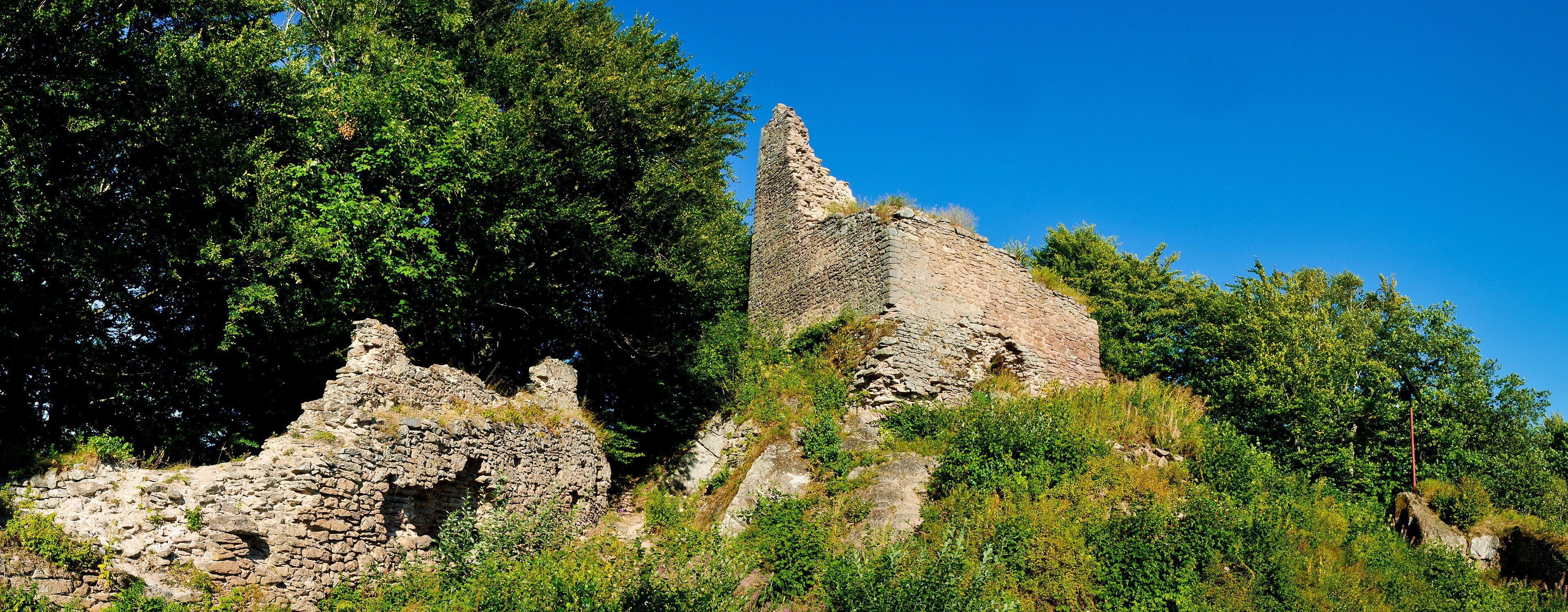
The mist kept the fortress from being seen whole. A chipped tower, a stretch of curtain wall overrun with moss, fallen stones over which tall grasses had grown. The fir trees had risen right beside the walls, and some roots entered the joints between the stones, loosening them slowly. The place seemed older than any person who might have spoken about it.
There was no one at the gate. Only a thin rope tied between two stakes, with notched pieces of wood hanging from it. Márton looked at them without touching them. Some of the marks were familiar to him, though he could not have named them. Spirals, broken lines, small circles burned with iron. One resembled the sign his grandmother made in the flour before baking bread, then quickly wiped away with the heel of her hand.
From inside, a dog barked once.
Then the woman appeared.
She was taller than he remembered. Her name was Réka. She had once come down into the village to trade, with other people from the fortress, but that had been years before, before the order from the court demanded that everyone in the region receive baptism and come to services. Márton had seen her then beside the well, wearing a grey coat and looking at people as if they were distant relatives who had forgotten the language of the house.
Now her hair was tied at the nape of her neck, and she held a small axe in one hand. She did not raise it. Nor did she smile.
“You came from below,” she said.
“Yes.”
“We know.”
She did not ask why. She untied the rope and let him in.
There were few people in the courtyard. Fewer than they said in the village. Twelve, perhaps fifteen, if one counted the thin children watching from the shadow of a wall. A woman was turning roots on a cloth. A man with a bandaged hand was repairing a basket. Two old men sat beside a small fire, though it was not cold. They did not speak. The smoke rose straight for a few cubits, then was caught by the mist and undone within it.
Márton smelled sour milk, wet wood, old smoke sunk into clothing. Nothing of what was told below. No wild gathering, no strange song, no burning defiance. Only tired people, who seemed to go on living out of stubbornness and out of the shame of descending too late.
Réka led him to the large shelter, built against the northern wall. There was old Ákos.
He found him seated on a bench, a short knife in his hand, stripping bark from a branch. His hands trembled slightly. Beside him, on the wall, hung bundles of dried herbs, animal skins, and several thin wooden tablets, notched with marks. None resembled an icon. None resembled a face.
“You are Ilona’s boy,” the old man said without raising his eyes.
“Yes.”
“Did she ever come all the way down?”
Márton did not answer at once. He knew what he was asking.
“She died a Christian,” he said.
Ákos smiled, barely.
“That is not an answer.”
The old man went on stripping the branch. The bark fell in thin strips onto the earthen floor.
“I came to tell you that you must come down,” Márton said. “The winter will be hard. The villages will no longer send flour. The guards at the passes will no longer look away. The priest says no one wants blood.”
“Is the priest a good man?”
“Yes.”
“Then do not send him too often with heavy words.”
Márton felt the wooden cross beneath his shirt. Beyond the door, the mist had entered the courtyard.
“It is no longer as it was,” he said. “Not below, either. People receive baptism. They put crosses on graves. They go to service. Some still do what they did before, but in secret. In time…”
He stopped. In time what? They forget? They grow used to it? They pretend until they no longer know they were pretending?
Ákos raised his eyes. They were clear, but tired.
“Did you come to save us, or to count us?”
There was no harshness in the question. That was why it hurt.
That evening, Márton remained in the fortress. Réka spread a blanket for him beside the shelter wall and brought him a bowl of boiled millet. No one asked him anything. They did not treat him as an enemy, but not as a guest either. It was something between the two, a state without a name, like when a relative long gone returns and no longer knows where to put his hands.
After darkness fell, the people gathered in the courtyard. The fire was lit again, not large, only enough to keep the light close to the ground. A child brought a flat stone and placed it beside the embers. Réka sprinkled something dry upon it. It did not smell of incense. It smelled of bitter leaves and earth brought out from under snow.
Ákos stood leaning on a staff. He said no prayers. Or, if he did, the words were so low they seemed more like breath. The others lowered their heads. A woman made the same gesture three times: she touched her forehead, then her chest, then the stone of the wall. A man placed a piece of bread beside the fire. No one looked at Márton.
Then he felt how little remained of that world. Gestures without a whole story. Signs kept by hands, not by the mind. Inherited fears without names. Perhaps not even Ákos knew everything anymore. Perhaps not even his parents had known. But these people clung to them like to an old, torn coat, one that no longer protects from the cold and yet cannot be thrown away, because it once belonged to someone loved.
When the fire sank low, Réka came beside him.
“Is it easier for you below?”
Márton looked towards the fortress gate. It could not be seen through the mist.
“No.”
“But you say it must be so.”
“Not I.”
“Yes. You too.”
It was not an accusation. It was a statement.
Márton rubbed his palms together. He was cold, though he sat close to the embers.
“You cannot live forever against the world.”
Réka took a branch and pushed the burned bread nearer the fire.
“But you can die that way.”
He wanted to tell her it was madness. That death preserves nothing. That the village would forget them, and the children below would grow up without knowing why some people had stayed in a broken fortress until winter or hunger overcame them. But he did not say it. Those words seemed too clean for the place where he stood.
That night he slept little. The wind passed through the gaps in the wall and made the timbers creak. Several times he thought he heard footsteps outside, then understood they were drops falling from the roof. He dreamed of his grandmother’s house, with the hearth gone cold and the table set for people who no longer came. He dreamed of the church below, but its door opened into the forest. When he woke, he did not know if it was before dawn or after. The mist made all hours the same.
In the morning, Ákos called him to the edge of the fortress, where the wall had fallen and the mountain dropped steeply toward the forest. From there, on clear days, one could see the villages, the smoke of households, the church tower. Now nothing could be seen. Only a white sea, unmoving.
“When I was a child,” the old man said, “people came up here from three valleys. They came with questions. With sickness. With restless dead. With weddings. With fear of drought. Not for me. I was no one. They came because here they knew how to stand differently. How to listen to stone, water, tree. Not as to gods. I do not know if we had gods, as your priest says. Perhaps we only had shame before things.”
Márton was silent.
“Now,” Ákos continued, “those below have another road. Perhaps better. Perhaps straighter. But we do not know how to walk it without stepping over our own.”
The old man took from his breast a small piece of wood, blackened at the edges. A sign had been carved into it: three lines beginning from the same point and opening like branches.
“Take it.”
“I cannot.”
“I did not ask you to pray to it. Only not to leave it here, if the walls fall.”
Márton received it. The wood was light. Too light for how heavily it weighed on him.
That day he tried again to persuade them. He spoke to them of winter, of flour, of children, of the fact that no one would ask them to forget their dead in a single day. He told them they could come down and live. That they could keep certain things in their houses, in silence, as many had done.
The people listened without interrupting him. Some looked at the ground. A woman wept quietly, without sound. One of the men, younger than the others, seemed as if he wanted to say yes. But beside him stood his mother, dry and straight, and her hand held his sleeve tightly, as if he were a child.
Toward evening, three decided to descend: the young man, his wife, and their little girl. They were not stopped. Réka gave them a bag with hard flatbread. Ákos touched their foreheads, one by one, but said nothing. The little girl was crying because she had forgotten a rag doll. Réka went back for it and brought it to her, shaking the ash from it.
Márton ought to have felt relief. Instead, a dull sadness took hold of him. The three were not leaving like people saved, but like survivors of a house burning slowly, without flame.
They set out together on the path at daybreak.
The fortress remained behind. Through the fir trees, the walls appeared and vanished in the mist until they could no longer be seen. Réka stood at the gate. Márton did not know whether she was watching him or those who were descending. Ákos could not be seen.
The road was harder going down than it had been going up. The mist had risen from the valleys and filled the forest. The young man walked ahead, keeping his axe at his belt. The woman came after him with the girl in her arms. In a clearing where the trunks had been burned by lightning, the woman stopped and began to tremble.
“We cannot,” she said.
Her husband turned back.
“We can.”
“Not there.”
She had not said “below.” She had said “there,” as if speaking of a foreign place where people breathed another air.
Márton did not intervene. He thought of his mother, of the way she knelt in church, yet at home kept silence near the hearth. He thought that perhaps a life between two faiths was not a bridge, but a cut. Some learned to live that way. Others bled slowly, without knowing from where.
When they reached the edge of the village, the bell was ringing. The sound came clean through the mist, too clean. The little girl covered her ears. Her mother took one step back. The man remained motionless, his eyes on the first houses.
Father Benedek was waiting for them beside the cross at the crossroads. He wore no vestments. Only his black coat, wet at the hem. When he saw them, he bowed his head, as before people who had come from far away.
“Welcome,” he said.
The woman did not answer. The man took off his cap. The little girl hid behind her mother.
Márton looked back. From there, the fortress could not be seen. Nor the whole mountain. Only the forest, a dark mass under the white sky.
In the weeks that followed, two more came down. Then no one.
Winter came early. Snow covered the paths and broke heavy branches across the roads. The villages went on with their lives. The children learned new carols. The women baked bread for the holidays. In church, the priest sometimes mentioned “those lost in the heights,” but he gave no names.
Márton went up once after the first snow.
He did not reach the gate. The road had vanished under snow and mist. At the stream with the black stones, he found a bundle of firewood placed under a beech tree, carefully covered with fir branches. Beside it, stuck into the snow, was a branch stripped of bark, with three lines notched at the end.
He did not know whether it was a sign for him, a boundary, thanks, or a warning.
He stood there a long time, with snow entering his peasant shoes. Then he took the wooden cross from beneath his shirt and held it in his palm, beside the sign Ákos had given him. Two small pieces of wood. Two ways of keeping the world from coming apart. Neither seemed enough.
He did not pray. Or perhaps he prayed without words.
In spring, when the snows melted, several men went up to the fortress. They found the fires extinguished, the shelters empty, a few broken vessels, old footprints hardened in the mud. In a niche in the wall, someone had placed a piece of dry bread and a sprig of fir. On the stone beside the gate, signs had been scratched that no one could read anymore.
No bodies were found.
Some said the people had gone over the mountains. Others said they had died in the forest and the beasts had scattered their bones. Father Benedek said only that God would judge them more gently than men. The old women in the village kept silent. Their silence had another weight.
In time, the fortress was left to the forest. The walls hid beneath moss, fir trees grew in the courtyard, and the road became harder and harder to find.
Márton grew old in the village below. He went to church, baptized his children, buried his dead with a cross at their head. But every year, before the first snow, he climbed to the stream with the black stones and left a piece of bread under the beech tree. He did not know for whom. He did not tell his children why.
One autumn, his youngest son asked him:
“Father, who lived up there, in the fortress?”
Márton looked towards the mist-covered mountain.
He could have said: the pagans. He could have said: the stubborn ones. He could have said: those who refused to understand time.
But no word fit in his mouth.
“People,” he said at last. “People who remembered differently.”