Skip to content
LEGENDS
OF ROMANIA
RO
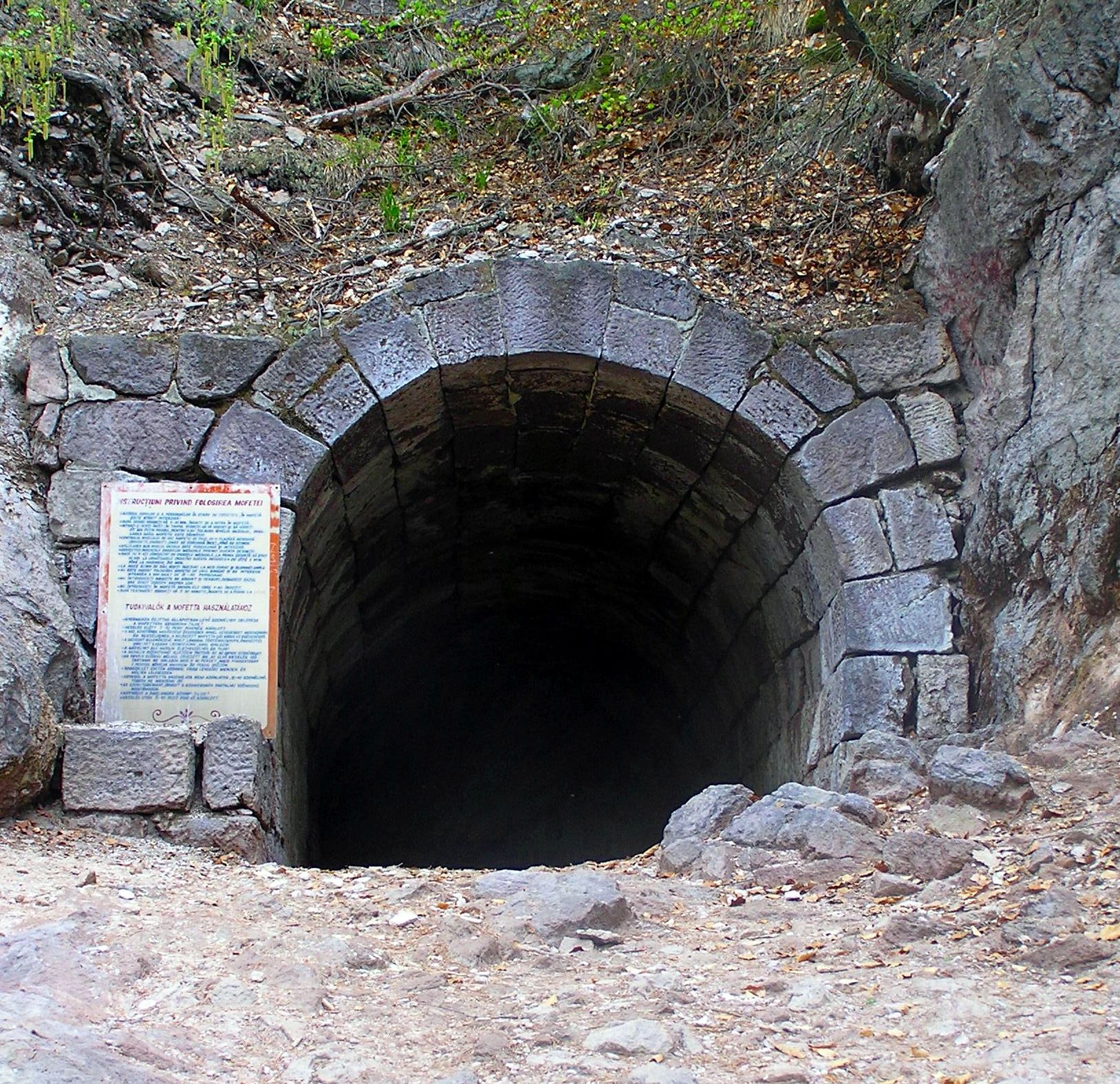
The arranged entrance to Puturosu Cave near Turia.

Depths

Puturosu Cave · Bálványos / Turia

Puturosu Cave

A sulphurous cave on Puturosu Mountain, where dense air, yellow crusts, and natural emissions make the place seem alive.

Photo: Ithildraug · CC BY 3.0 · cropped and optimised for the web

Quick facts and editorial frame

The place at a glance

Real place
Puturosu Cave / Sulphurous Cave[1][5]
Type
Modified sulphurous cavity / natural mofetta[1][5][7]
Region
Bálványos Pass, Turia commune[1][2]
Altitude
Approx. 1,052 m

Elevation published in a 1980–1981 physicochemical study.

[6]
Visit duration
Balvanyos Resort–Sulphur Cave–Balvanyos Resort car park thematic loop: approx. 2 km, 120 m elevation difference, 1–1.5 hours[2]
Access
On the first section of the Puturosu Mountain thematic trail, starting and finishing at Balvanyos Resort

Published figures for this section are approx. 2 km, 120 m elevation difference, and 1–1.5 hours. Confirm access and obey restrictions displayed on site.

[2]
Season
No official calendar was identified; confirm access and trail conditions before setting out
Suitable for
Nature, geology, photography, quiet travel

Featured legend

The Place Where the Earth Breathes

Four fictional field notes about a sulphurous cave, a breath rising from stone, and the things some places do not heal, but bring to the surface.

Entry I — Arrival

I came to Bálványos for what the doctors called recovery and what I called, without telling anyone, a postponement.

Illness had not made me dramatic. I did not feel that I was fighting anything. Rather, I woke each morning with the impression that someone had moved the furniture inside me during the night. Things were still there, but I could no longer find their place. I breathed, walked, answered messages, ate soup, took pills. And yet something in me had withdrawn into a room without light.

The woman at the guesthouse told me about Puturosu Cave while she cleared the table. Her hands were red from the cold water, and she held a towel between her fingers.

“The earth breathes there,” she said. “Not like here.”

I thought it was one of those stories people use to give weight to a local attraction.

“Some come and feel better,” she continued. “Others come and no longer know why they came.”

Then she looked at me carefully.

“If you go up, do not go too far in. Stay as long as you feel you can, but do not be stubborn.”

I smiled, perhaps too politely. We had each read the warning differently. She was talking about the place. I was thinking about my lungs.

Entry II — First entry

I set out alone the following morning. It was the end of October. Wet leaves clung to my boots, and the spruce trunks were swollen with water. I could hear drops falling from the branches and, now and then, my own breathing.

At first I walked quickly, with the stubbornness of a man who wants to prove something to himself. After a few hundred metres, my lungs asked me to slow down. I leant against a tree and waited. In the city, the sound of my breathing had seemed shameful. Here it was only one faint noise among others.

I smelt it before I saw the cave. It was not merely the smell of rotten eggs. It had layers: sulphur, dampness, warm stone, something metallic and old, like a cellar where rusty tools and rotting apples had been kept. The air thickened as I went on. I could feel it on my tongue.

The entrance was modest. A dark opening in the rock, without grandeur. The stone around it was wet, stained yellow and grey. Vapour rose almost imperceptibly from ground level. I placed my palm against the wall. It was warm in a way that did not belong to the cold morning.

I had reread the warnings before leaving: gases gather low down; do not sit; do not lower your head; do not remain if symptoms appear. I went in a few steps and held myself upright, my chin lifting without my meaning it to.

The air inside seemed to have weight. Water ran down the walls in thin threads, and the stone was marked here and there with yellow stains. There was nothing spectacular to see. A hollow, a few rocks, little light.

I stayed perhaps ten minutes. Perhaps less. At one point I heard a very low, regular sound that seemed to come from the stone. I knew it could be my own blood in my ears or gas escaping through cracks.

Even so, after several breaths, I noticed that I was trying to breathe in the same rhythm.

I was frightened not by the cave, but by my own listening.

When I came out, my knees were weak. I descended slowly, and that evening I slept for almost twelve hours.

Towards morning, I dreamt of my mother’s kitchen, before she became ill. Outside, it was snowing. She was peeling potatoes and speaking to me without looking at me. I do not remember what she said. In the dream, the words did not matter, only that her hands were whole, quick, alive.

When I woke, the room smelt faintly of sulphur, although the window had been closed.

I blamed my clothes. My hair. My skin.

Entry III — The returns

Over the following days, I went up again. At first I told myself I was exercising. Then that I wanted to understand why people spoke more softly near the cave.

Some stopped at the edge, breathed in once, and left. A young woman came with her father and held him by the elbow while he stood at the entrance with his eyes closed. When they left, the man was crying.

He did not seem healed. Nor ruined. He seemed only to have remembered something he had not asked to remember.

I did not cry. I repeated that to myself with ridiculous satisfaction. I was not that man. I was not the kind of person who looked for signs.

On the fourth day, I noticed that before going in, I took my phone from my pocket and switched it off. Not because of the signal. Out of respect, the thought crossed my mind. Then I became angry with myself.

I began to record small things. A drop always fell from the same place, but sometimes its sound seemed farther away. My shadow thinned when clouds covered the sun, but once I had the impression that it lagged behind by a fraction of a second.

Light. Fatigue. Lack of oxygen. Suggestion.

I could explain every observation.

It was harder to explain why, after every visit, I felt less enraged.

Not better. Not healthier. The tests had not changed. The dull pain in my chest came and went according to its own schedule. But despair, which before had taken the shape of a room without doors, had begun to resemble a valley. Still enclosed, perhaps, but with sky above it.

One afternoon, the woman at the guesthouse asked whether I was going again.

“It is only a cave with gases,” I told her.

She was setting plates on the table. She stopped for a moment.

“Yes. And a man is only water and flesh, if you cut him down far enough.”

Then she continued laying out the cutlery.

That night I dreamt of my flat in Bucharest. It was empty, but all the lights were on. In the rooms, I found objects I had thrown away years before: a chipped mug, a green jumper, a notebook from university.

My medicine bottle stood on the table in the sitting room. In the dream, its cap rose and fell slowly, pushed from within by a breath.

I woke calm. That was the most troubling part.

Entry IV — Departure

On the final morning, the woman at the guesthouse found me dressed to leave.

“You are leaving today?”

“After I go up once more.”

She folded the towel she was holding.

“Then do not ask for anything.”

“I have not asked for anything so far.”

She looked at me with the same attentive eyes as on the first evening.

“Exactly.”

I went up alone.

The air was heavier than on the other days. Or perhaps I was more tired. The smell of sulphur filled my mouth, my nostrils, and my throat. The warm stone seemed to pulse beneath my palm. It was not a real pulse. My hand was trembling.

From the narrow depth of the cave came the slow breath I had recorded each time. The earth breathed without caring that I was listening.

I thought of the doctor who had spoken to me with professional gentleness, of my mother in the kitchen, of the messages I had not answered, of the mornings when I had wanted the day to pass before it began.

I waited for relief, fear, or revelation.

Nothing happened.

Only that, for the first time in many months, I no longer felt obliged to defend myself from my own life.

I remained until my knees weakened and the air became too dense in my chest. Then I went out.

On the way back, I noticed unimportant things: a broken mushroom beside the root of a spruce, an animal’s track in the mud, a thread of water crossing the path with a yellow leaf. I stopped to watch it. The leaf caught on a stone, trembled, then came free on its own.

I was not healed at Bálványos. It would be a lie, and disrespectful to the place, to say that. Nor was I miraculously changed. When I reached home, the same envelopes waited on the table, the same appointments in the calendar, the same body and the same fear.

But sometimes, especially in the morning before the city fills with noise, I have the sense that beneath the floor there is a slow breath. I do not hear it. It is only the memory of warmth rising from stone and of heavy air that promised nothing.

Then, for a few moments, I understand that not all places are made to save you.

Some only hold you still long enough to see what you brought with you.
Documented folklore

Reported local legends

These stories are traditions or accounts associated with the place, not confirmed historical facts and not the original fiction published by Legends of Romania.

01 · Reported

Apor István, turned back on the road to the cave

In a tradition recorded by Orbán Balázs in 1869, Apor István loves a daughter of the Mike family, but they are forbidden to marry because he retains the old faith. In despair, he sets out for the deadly cave on Puturosu Mountain before a priest of Hadúr turns him back and proposes that he abduct the young woman.

The association belongs within the wider Apor family and Bálványos Fortress traditions and should not be turned into an origin legend for the cave.

A regional story recorded in a nineteenth-century work; it is not presented as verified history. The cave is Apor’s intended destination, not the origin of the wider conversion and marriage legend.

[12]

The real place

What is true here

Behind the smell and dramatic name lies a stratified chemical system, a long history of measurement, and a microscopic ecosystem capable of living in an extreme environment.

01

Science

Well documented

It is not the mouth of an active crater

The cave lies on Puturosu Mountain, on the south-eastern edge of the Ciomad volcanic complex. Institutional sources call the mofettas and solfataras cold post-volcanic phenomena, while modern isotope research shows that the long-dormant volcanic system continues to degas and includes a magmatic component.

[3][5][8]

02

Science

Well documented

Air above, mofettic gas below

A lower anoxic layer dominated by CO₂ also contains CH₄ and H₂S, while oxygen-bearing atmospheric air lies above it. Their interface is a relatively stable gas chemocline. Not every component is a heavy gas: methane is lighter than air, and the mixture’s stratification is dominated by its large proportion of CO₂.

[5][6]

03

Science

Well documented

A chemical boundary written on the wall

The yellow coating is a crust of elemental sulphur, not ‘petrified sulphur’. Elemental sulphur and sulphuric acid produced by sulphur oxidation occur at and below the chemocline; the wall surface near the interface can have a pH below 1, and acid-loving biofilms follow this zone. The crust records the interface’s approximate persistent position, not a real-time safe gas level.

[5][9]

04

History

No consensus

Mine adit or modified natural cavity?

The local portal describes it as the abandoned adit of a sulphur mine. A 1941 geological study, however, calls the original cavity natural, while research from 1980–1981 documents certain human alterations: about 7 metres lined with stone in 1892, restoration in 1972–1973, and iron bars installed in 1973. Its heavily modified character is certain; an entirely artificial origin should not be stated without qualification.

[1][6][7]

05

Science

Source-based estimate

There is no single verified contemporary figure

Ilosvay estimated approximately 2,021 cubic metres of gas per day. In July 1973, measurements produced approximately 3,960 m³/day with an anemometer and 3,830 m³/day by a second method. More recent public sources publish either 2,000 or 3,000 m³/day, so any figure must be dated and qualified rather than presented as a constant measured today.

[6][1][4][3]

06

History

Well documented

A natural laboratory studied for more than a century

In 1884, the Royal Hungarian Society of Natural Sciences launched an open competition, and chemist Lajos Ilosvay submitted a plan to investigate the cave air; after repeated field campaigns, he published his monograph in 1895. Measurements were repeated in 1973, and a 2018 interdisciplinary study examined the geology, mineralogy, chemistry, and microbiology of the same environment.

[10][6][5]

07

Culture

Well documented

Hell’s porch, in Jókai’s words

In his 1883 novel Bálványosvár, Mór Jókai uses the Hungarian phrase pokol tornáca for the Büdös landscape and writes at the cave mouth: ‘Itt van a pokol tornáca’ — ‘Here is hell’s porch.’ The Romanian phrases ‘Tinda iadului’ and ‘porticul iadului’ are modern renderings of the same literary association, not two independent local traditions.

[13]

08

Unexpected fact

Well documented

A microbe that lives on methane

Researchers cultivated a proposed species, Candidatus Mycobacterium methanotrophicum, from the cave’s acidic biofilm. Experiments using isotope-labelled methane confirmed that it can use methane as its sole source of carbon and energy — the first demonstration of this aerobic metabolism among the Actinobacteria.

[9][5]

At a glance

Reference facts

Place identity

Place type
Heavily modified cavity containing a natural sulphurous mofetta; sources differ on its origin[1][5][7]
Location
Bálványos Pass, southern side of Puturosu Mountain, Turia commune[6][2]
Context
Area with cold mofettic emissions termed post-volcanic in the management plan; the Ciomad system is still degassing[3][8]

Geographic facts

Altitude
Approx. 1,052 m[6]
Cavity length
Approx. 14 m; about 7 m were lined with stone in 1892The 7-metre figure describes a historic alteration, not a currently verified safe area.[1][6][5]

Gas and cave

Emissions
Anoxic CO₂-dominated layer containing CH₄ and H₂S, with oxygen-bearing air above[5][6]
Reported flow
Published values differ: approx. 2,000–3,000 m³/day in public sources and 3,830–3,960 m³/day in 1973 measurements[3][4][1][6]
Yellow crust
Elemental sulphur associated with the chemocline’s approximate position; it does not indicate a real-time safe level[5][9]

Historical notes

Origin
The local portal describes it as an abandoned mine adit; a 1941 geological study considers the original cavity natural[1][7]
Documented alterations
About 7 m lined with stone in 1892, restoration in 1972–1973, and iron bars installed in 1973[6]

Visiting notes

Safety
The lower section contains oxygen-poor air and potentially lethal gases; do not cross barriers and obey current restrictions displayed on site[5][1][14][15]
Exposure
Smell is not a reliable H₂S detector; if you feel unwell, leave immediately and seek assistance; do not use the cave as an unsupervised treatment[14][15][5]

Visiting guide

Practical notes

Accessibility
Walking accessThe published route follows the first section of the Puturosu Mountain thematic trail: Balvanyos Resort–Sulphur Cave–Balvanyos Resort car park, an approx. 2 km loop. Confirm current access before setting out and obey all barriers and warnings on site.
Time & Season
1–1.5 Hours for the short thematic loop of approx. 2 km · No official season is published; confirm access and trail conditionsIdeal time: In daylight, after confirming current access
01

Getting there

The published route follows the first section of the Puturosu Mountain thematic trail from Balvanyos Resort to the Sulphur Cave and back to the resort car park. The loop is approx. 2 km, has a 120 m elevation difference, and takes 1–1.5 hours. Confirm current access before setting out.

02

When to go

No current official calendar for the cave was identified. Confirm access before setting out and choose conditions in which the trail can be followed safely in daylight.

03

Is it suitable for children?

The all-ages recommendation applies to the first trail section, not exposure to cave gases. Supervise children at all times and obey every barrier, closure, and warning displayed on site.

04

Keep in mind

High CO₂ concentrations and H₂S can cause rapid incapacity, and smell does not provide a reliable warning. Do not cross barriers, use a flame, or treat the cave as an unsupervised therapy.

Before you go

Safety is part of the journey.

The lower section contains an oxygen-poor mixture dominated by CO₂, with H₂S and CH₄. Do not cross barriers, use a flame, or treat smell or the yellow crust as indicators of a safe area. If you feel unwell, leave immediately and seek assistance.

Practical information checked 3 September 2026

  • On the day of your visit, check weather, closures, opening information, and local rules in the official resources.
  • Stay on marked, permitted routes. Turn back if markings, weather, or terrain become unclear or unsafe.
  • Avoid going alone and tell someone your route and expected return time.
  • Carry an offline map, charged phone, water, changing-weather layers, and a first-aid kit; mobile coverage is not guaranteed.
  • Keep your distance from wildlife, never feed it, and follow local bear alerts and instructions.

Official resources and updates

In an emergency, call 112 or 0SALVAMONT (+40 725 826 668) and provide your location and the group’s condition.

Field detail

Notice this

Read the yellow elemental-sulphur crust as the trace of a persistent chemical boundary, not as a real-time indicator of a safe level.

Location

Where it is

The pin shows the attraction location for orientation. It is not automatically a car park, trailhead, or proof of vehicle access.

Documentation

References

Numbers in the text point to the list below. Titles open the external source used for verification.

  1. [1]Touristic attractions — Asociația Vinca Minor – Ciomad–Bálványos
  2. [2]Puturosu Mountain thematic trail — Asociația Vinca Minor – Ciomad–Bálványos
  3. [3]Plan de management din 25 ianuarie 2016 al sitului Natura 2000 ROSCI0037 Ciomad Balvanyos — Portal Legislativ, Ministerul Justiției
  4. [4]Turism în județul Covasna — Consiliul Județean Covasna
  5. [5]Sulfur Cave (Romania), an extreme environment with microbial mats in a CO₂-H₂S/O₂ gas chemocline dominated by mycobacteria — International Journal of Speleology
  6. [6]Újabb fiziko-kémiai vizsgálatok a torjai büdösbarlangban — Aluta / OSZK Electronic Periodicals Archive
  7. [7]A torjai Büdöshegy vulkánológiai viszonyai — Royal Hungarian Geological Institute / OSZK EPA
  8. [8]Noble Gas and Carbon Isotope Systematics at the Seemingly Inactive Ciomadul Volcano: Evidence for Volcanic Degassing — Geochemistry, Geophysics, Geosystems
  9. [9]Methanotrophy by a Mycobacterium species that dominates a cave microbial ecosystem — Nature Microbiology
  10. [10]Ilosvay Lajos — Akadémiai Kiadó / MTA Könyvtár
  11. [11]XIII. A torjai Büdös — Magyar Elektronikus Könyvtár, Országos Széchényi Könyvtár
  12. [12]XIV. A Bálványos és Torja vára — Magyar Elektronikus Könyvtár, Országos Széchényi Könyvtár
  13. [13]Bálványosvár — Magyar Elektronikus Könyvtár, Országos Széchényi Könyvtár
  14. [14]Offshore COSHH essentials OCE6: Hydrogen sulphide — UK Health and Safety Executive
  15. [15]NIOSH Pocket Guide to Chemical Hazards: Carbon dioxide — US CDC / NIOSH