Skip to content
LEGENDS
OF ROMANIA
RO
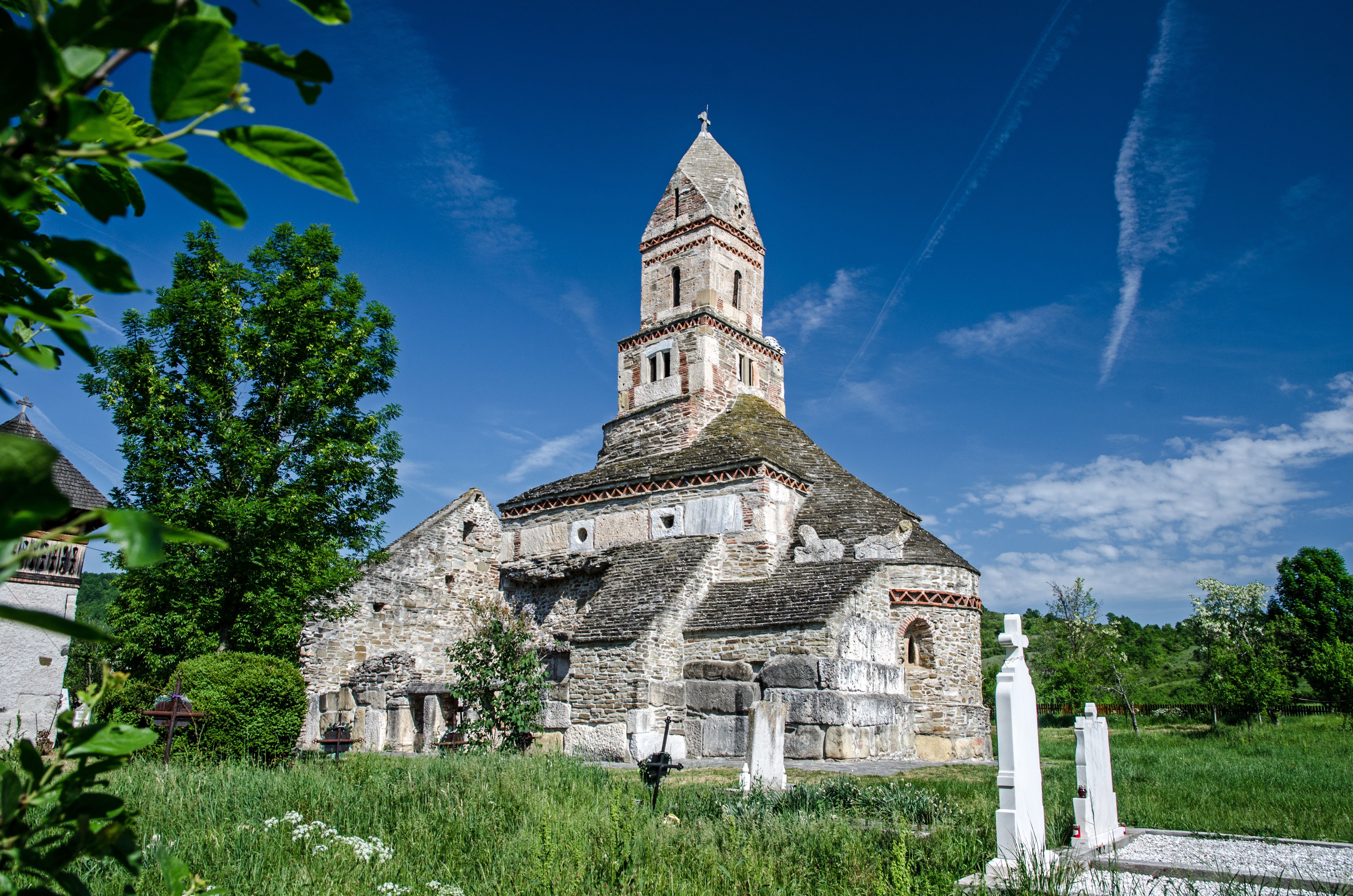
The stone church at Densuș seen from the cemetery, with its apse, stone-slab roof, and central tower.

Faith

St Nicholas Church, Densuș · Hațeg Country

Densuș Church

A living medieval church built with reused Roman fragments, where stone, painting, and community care belong to different periods.

Photo: Sebastian Mierzwa · CC BY-SA 4.0 · cropped and optimised for the web

Quick facts and editorial frame

The place at a glance

Real place
St Nicholas Church, Densuș[1][2]
Type
Active Orthodox church and nationally important architectural monument[1][12][13]
Address
No. 23, Densuș village, Densuș commune, Hunedoara County[1][2]
Heritage records
LMI HD-II-m-A-03307; RAN 89357.01[1][2]
UNESCO status
On Romania's Tentative List since 1991; not inscribed as World Heritage[3]
Chronology
Officially dated principally to the thirteenth century; the earliest phase remains debated[1][2][3][7]
Access
Active place of worship; confirm interior access if it is essential[12][13]
Before visiting
No official visitor hours, parking, accessibility, or photography policy is published

This describes the official information checked on 4 September 2026; it does not establish that no rules are posted locally.

[12][14]

Featured legend

The Keeping of the Stone

Four hands, four ages, and a single word passed on through the care of a church built from stone older than the church itself.

The First Hand — The Stone

The block was heavier than it looked. It had one straight edge, two broken corners, and letters cut into one face. The apprentice could not read them. The master did not pretend to understand them either.

‘It had been set somewhere before,’ he said. ‘That much we know.’

They had brought it from among the ruins with other stones: some smooth, others hollowed, a few blackened by the weather. None matched the others, yet all went into the new wall. The master tried them one by one, looking for a level position and tapping each lightly with the handle of his tool.

He had prepared a place for the inscribed block at the foot of one of the supports. The apprentice asked whether it should be turned with the writing facing inwards.

‘Why?’

‘So no one can see what we do not understand.’

The master measured the edge again. If they turned it, the broken corner would bear the weight. As it stood, the straight face could receive the stone above.

‘We do not need to understand its letters to set it properly,’ he said.

They secured the block with ropes. The others lifted while the apprentice slid a wooden wedge beneath it. The stone moved a hand's breadth, then another.

‘Hold,’ the master told him.

The boy pressed the wedge with both hands. The rope burnt his wrist, dust entered his mouth, and for a moment he thought the weight of the entire tower was bearing down on him. He did not let go.

The master pressed mortar into the joint and tapped the block until it no longer shifted. The letters remained visible. Not as a message and not as a sign. It was simply the face upon which the stone stood most securely.

The Second Hand — The Ladder

After enough winters, no one remembered the apprentice's name. The stone remained in the support, its letters worn by hands, smoke, and damp.

One morning, a painter was trying to finish a saint's face before the feast day. Little light entered, and the ladder's bottom rung stood unevenly on the floor slabs.

A woman who had come to clean the candlesticks held the ladder with both hands.

‘Further left,’ the painter said.

‘Like this?’

‘A little more. Hold.’

The woman held it. The painter climbed up and down, asking in turn for the bowl of colour, the cloth, and more light. At one point, a red drop fell onto the inscribed block.

‘Leave it,’ he said from above. ‘I will wipe it when I come down.’

The woman saw the stain but did not take either hand off the ladder.

‘Hold,’ the painter repeated.

‘I am holding it.’

Only after he had climbed down did she take the cloth and clean away the colour before it set.

Above them, a new face was taking shape. Beneath her hands remained an old inscription. The woman did not fully understand either one, but she knew what she had to do until the man was safely down.

When the bell called the village, the painter gathered his colours and she carried the cloth to the water. No one called the gesture a ritual. The following Sunday, someone else held his ladder.

The Third Hand — The Joint

Much later, water found its way beneath a roof slab and down through the wall. The mortar around the inscribed block crumbled. The stone had not fallen, but the joint sounded hollow when the mason tested it.

The church's caretaker watched him tap lightly around it.

‘We take it out,’ he said. ‘We put in a new one and finish by tomorrow.’

‘Can it not be set again?’

The mason shrugged.

‘It can. But we would have to support everything bearing down on it. We need timber, ropes, and people. Two days, if it does not rain.’

Clouds were already gathering over the village. The books, textiles, and vessels in the church had to be moved out of harm's way. Sunday was drawing near.

The mason traced a finger through the air without touching the letters.

‘Do you know what they say?’

‘No.’

‘Then why keep it?’

The question came from a tired man, not a careless one. The mason was right: a new stone could bear the same weight, perhaps even better. The old one required time and workers the village would have to draw away from other tasks.

The caretaker looked at the block, then at the damp stain descending from the roof.

‘If we can reset it safely, we will. If we can't, we'll take it out.’

‘That doesn't decide anything.’

‘It does. I've decided that first we find out what we can do without damaging what we have.’

They began only once the church was empty and the books, textiles, and vessels had been moved to safety. Some brought beams, others ropes and wedges. The mason built the support and showed them where to place their hands. No one worked if the timber shifted.

‘Hold here.’

‘I am holding.’

‘Do not slacken the rope.’

‘I will not.’

They loosened the block only enough to clear away the crumbled mortar. The narrow gap around it revealed rough stone, dust, and traces of the old mortar. They packed in fresh mortar, replaced the wedge, and reset the block.

The work took two days. It rained overnight, and people came to check the tarpaulins. Once the support had been removed, the mason tested the joint again with the handle of his tool.

This time, the tap sounded solid.

The Fourth Hand — Hold

More years passed. The new mortar gradually took on the colour of the old. Only a thin line of the repair remained visible to those who knew where to look.

One day, a child came with the man inspecting the wall after winter. The child carried a small, almost empty bucket and asked about every stone.

‘Where did this one come from?’

‘We do not know for certain.’

‘What about the letters?’

‘They are Roman.’

‘What do they say?’

The man showed the child the letters he could make out and the chipped edges. He did not pretend to know any more about the stone's journey to the wall. The child counted the old joints and the repaired ones, then wanted to know whose hands had made them.

‘We no longer know them all,’ the man said.

The man placed a short board beneath the bucket, several paces from the wall. He was going to clear the joint and fill the crack; he gave the child a wooden wedge and asked only that the board be kept level on the uneven ground.

The child put the wedge where he had been shown.

‘Like this?’

The man pressed the board and checked that it was level.

‘A little more. Now hold.’

The child placed both palms on the wood.

‘I am holding.’
Documented folklore and reception

Traditions and interpretations associated with the place

These accounts separate oral tradition and local legend from the documented history of how the place has been interpreted. None is presented as confirmed historical fact or as original Legends of Romania fiction.

01 · Traditional

Zafira and the tower gallery

Aron Densușianu called the story of Zafira a ‘popular tradition’. Her parents wanted her to marry a wealthy young man, but she loved a poor villager. Believing that her father had beaten her lover to death, Zafira supposedly hid in the tower's dark gallery, known as Zafira's Cave. When she heard her father publicly promise that she could choose her husband, she emerged, accused him, and threw herself from the church. In the account, the lover survives, and his night-time lament at her grave is said to have woken the neighbourhood.

Zafira's Cave is a cramped gallery or chamber associated with the tower and reached from the roof, not an underground cave or tunnel. Modern summaries sometimes call the 1864 journey the publication date; the serialised publication followed in 1865–1866.

Densușianu gathered the account during his 1864 journey and published the travel writing serially in Familia in 1865–1866. This establishes nineteenth-century printed provenance, not the date of the events or the age of oral transmission.

[16][17]

02 · Reported

The church built by giants

A local tradition reported in modern regional material attributes the church's massive and unusual masonry to giants.

Do not merge these giants automatically with the giant or fairy traditions attached to other Hunedoara places.

The account is presented as inherited local oral tradition, but no nineteenth-century collector or early printed version was identified. Its age and exact local variants remain unknown.

[19]

03 · Reception history

Antiquarian interpretations: Longinus, the mausoleum, and the temple of Mars

Antiquarian tradition interpreted the Densuș building at different times as a temple of Mars or the mausoleum of General Longinus. Aron Densușianu related that the body of the commander captured by Decebal was recovered and buried here, after which the Roman monument supposedly became a place of sacrifice to Mars.

Versions say either that Longinus built the monument or that Trajan raised it for him. Neither is established archaeology. Do not add human sacrifice: the cited account says only that sacrifices were made.

This is documented reception history, not verified archaeology or securely established local oral tradition. The Mars interpretation is traceable to Hohenhausen's 1775 antiquarian publication and the Longinus narrative to nineteenth-century writing. Epigraphy identifies the reused stone as the epitaph of Gaius Longinius Maximus, not Trajan's captured commander.

[18][17][10][11][6]

The real place

What is true here

The stone church at Densuș brings together Roman fragments, painting from several periods, and the traces of a community that still uses it within one compact medieval building. Precisely because its origins have generated spectacular hypotheses, the place should be read through what is secure, what remains debated, and the stories that arose between those two layers.

01

History

No consensus

A medieval church without one agreed starting date

Official records principally date the church to the thirteenth century, while UNESCO says it was standing no later than the fourteenth. Daniela Marcu-Istrate has proposed a tenth- or eleventh-century ecclesiastical core substantially rebuilt later. This is a serious scholarly hypothesis, not a consensus or evidence of an ancient temple.

RAN also preserves the older assertion of a fourth-century construction beneath the church; this does not establish that the surviving walls are ancient and is not presented as an equivalent consensus.

[1][2][3][6][7]

02

History

Well documented

Roman stones in a medieval building

Roman altars, columns, funerary inscriptions, drainage elements, and funerary lions were reused in the walls and tower supports. The spolia are real; they demonstrate medieval reuse of ancient material, not the proven conversion of a Roman temple into a church.

[2][3][6]

03

Culture

Well documented

A compact structure built upward

The compact nave, approximately 6 × 6 metres, is dominated by a tower resting on four central supports composed largely of reused Roman altars. The apse is semicircular, and a stone-slab roof contributes to the unusual silhouette.

[2][3]

04

Unexpected fact

Well documented

The Longinius stone belongs to another man

The funerary stone reused in a pier commemorates Gaius Longinius Maximus, who died aged 58, and was set up by his wife Iulia Afrodisia. He is not Trajan's general from the mausoleum tradition; the similarity of names fed a story, not an epigraphic identification.

[10][11]

05

History

Source-based estimate

A priest is documented in 1360, not a construction date

A priest named Dalc of Densuș appears in a document dated 2 June 1360, alongside clergy involved in a Hațeg judicial assembly. The reference demonstrates an organised Christian community, probably with a church, but does not directly date the masonry standing today.

[6][14]

06

Culture

Well documented

Ștefan and a 1443 mural campaign

The surviving murals include a campaign dated 1443 and associated with the painter Ștefan. Research distinguishes several hands and phases; not every visible painting belongs to the same artist.

[2][8]

07

History

Source-based estimate

A church within a cemetery and noble court

Research documented a large medieval cemetery and the remains of a fifteenth- to sixteenth-century noble court near the church. RAN summarises more than 130 graves, while the 2000 campaign report says 210 were wholly or partly investigated; the figures describe different reporting stages and should not be merged.

[2][4][5][6]

08

Science

Well documented

Restoration had to manage moisture, not only stone

Modern conservation addressed mural paint, salts, and rising damp rather than masonry stability alone. The project used chemical and stratigraphic investigation, while the climate study describes improved natural ventilation, perimeter drainage, and underfloor heating to control moisture.

[8][9]

At a glance

Reference facts

Place identity

Current function
Church of Densuș Parish in the Hațeg deanery[12][13]
Dedications documented in 2026
St Nicholas the Hierarch and the Prophet Jeremiah[13]
Protection
Individual Group-A architectural monument[1]
Setting
At the northern edge of the village, near the Orthodox cemetery and Pârâul Galben[2]
Orientation point
Approx. 45.58246, 22.80536; the coordinates mark the church, not parking[20][2]

Chronology and research

Official dating
Thirteenth century; additions variously dated to the fourteenth–fifteenth or fifteenth–seventeenth centuries[1][2]
Proposed earlier phase
A tenth- or eleventh-century ecclesiastical core proposed by Daniela Marcu-Istrate and rebuilt later; a hypothesis, not a consensus[7][6]
Fourth-century construction
An assertion preserved in the RAN record, without conclusive proof that the surviving walls are ancient[2][6]
1360 Reference
Dalc, a priest of Densuș, is documented at a Hațeg judicial assembly; the reference does not directly date the masonry[6][14]
Mural painting
A 1443 campaign associated with the painter Ștefan; several hands and phases are visible[2][8]

Architecture and materials

Nave
Compact plan, approximately 6 × 6 metres, with a tower above the central space[2][3]
Tower supports
Four central supports composed largely of reused Roman altars[3][6]
Apse and roof
Semicircular eastern apse and stone-slab roof covering[2]
Reused material
Roman altars, columns, funerary inscriptions, drainage elements, and funerary lions[2][3][6]

Visiting notes

Living church
Services and parish activity take priority over sightseeing[12][13]
Opening hours
No regular visitor schedule published by the parish or diocese was found[12][14]
Photography
No current policy is published; ask permission onsite and do not use flash without explicit approval[12][14]
Facilities
Parking, toilets, and accessibility are not officially documented in the sources checked[12][14]

Visiting guide

Practical notes

Accessibility
Rural access; confirm interior availabilityThe church stands at no. 23 on the northern edge of Densuș village. The coordinates mark the attraction, not parking. No official parking place, drop-off point, or accessible route was verified, and interior entry depends on parish activity.
Time & Season
Variable; no official visit duration was found · No official visiting season was verified; plan for local travel conditions and confirm interior access separatelyIdeal time: Outside services and parish activity; no official visitor schedule is published
01

Getting there

The heritage records give the address as no. 23, Densuș village, Densuș commune, Hunedoara County. The map point marks the church, not parking. No official parking place, coach drop-off point, or public-transport route was confirmed.

02

When to go

The parish and diocese do not publish regular visitor hours. If seeing the interior is essential, confirm with the parish beforehand and avoid planning a sightseeing visit during a service or community activity. Hours shown in map registries do not guarantee entry.

03

Is it suitable for children?

Yes, with supervision and an explanation that the site is both a living church and an active cemetery. Keep voices low, do not let children climb on stones or graves, and do not touch paintings, inscriptions, or masonry.

04

Keep in mind

Wear clothing appropriate to a place of worship and follow local instructions. Admission or donations, toilets, card payment, guiding, pushchair access, and accessibility equipment are not officially confirmed. Do not turn missing online information into a promise that these services either exist or are absent.

05

Photography

No current photography policy published by the parish was found. Ask permission before taking interior photographs, switch off flash, and stop photography during worship or whenever requested.

06

Accessibility

No official description of steps, terrain, ramps, handrails, or accessible parking is published. Contact the parish before travelling about the current route and available assistance; do not assume that proximity to the road guarantees step-free access.

Before you go

Safety is part of the journey.

Do not interrupt services, funerals, or parish activity for sightseeing. Ask permission before photographing the interior and contact the parish before travelling if accessibility or church entry is essential.

Practical information checked 4 September 2026

  • On the day of your visit, check opening information, closures, and rules in the official resources.
  • Use only areas open to visitors and respect barriers, signs, and instructions from staff or the community responsible for the place.
  • Take care on steps and uneven or slippery surfaces, and supervise children.
  • Keep your phone charged and adapt the visit to the weather and the conditions you find on arrival.

Official resources and updates

In an emergency, call 112 and describe the location and situation as clearly as possible.

Field detail

Notice this

Notice how blocks bearing Roman letters and forms serve structural roles beside medieval masonry. Do not infer the whole building's original function from a single stone, and do not touch the paintings or inscriptions.

Location

Where it is

The pin shows the attraction location for orientation. It is not automatically a car park, trailhead, or proof of vehicle access.

Exploration

Nearby traces

Documentation

References

Numbers in the text point to the list below. Titles open the external source used for verification.

  1. [1]Lista Monumentelor Istorice 2015 — Județul Hunedoara — Ministerul Culturii / Institutul Național al Patrimoniului
  2. [2]Situl Bisericii Sf. Nicolae din Densuș — cod RAN 89357.01 — Repertoriul Arheologic Național / Institutul Național al Patrimoniului
  3. [3]L'église de Densus — UNESCO World Heritage Centre
  4. [4]Densuș, com. Densuș, jud. Hunedoara — Biserica ortodoxă, campania 1999 — Cronica Cercetărilor Arheologice / CIMEC
  5. [5]Densuș, com. Densuș, jud. Hunedoara — Biserica ortodoxă, campania 2000 — Cronica Cercetărilor Arheologice / CIMEC
  6. [6]Biserica Sf. Nicolae și curtea nobiliară a Arceștilor de la Densuș (jud. Hunedoara) — Arheologia Medievală / Asociația Arheologilor Medieviști din România
  7. [7]Între fantezie și inginerie: cronologia bisericii ortodoxe „Sfântul Nicolae” din Densuș — Editura Oscar Print / Academia Română — Institutul de Istoria Artei „G. Oprescu”The citation follows the author's institutional bibliography: 2020, pp. 219–232; Academia.edu metadata differs.
  8. [8]Biserica „Sfântul Nicolae” din Densuș — restaurare, consolidare și punere în valoare — Uniunea Națională a Restauratorilor de Monumente Istorice
  9. [9]Heritage and Climate Changes in Romania: The St. Nicholas Church of Densus, from Degradation to Restoration — Energy Procedia 133 / Elsevier
  10. [10]Epitaph from Colonia Ulpia Traiana Sarmizegetusa, aus — Densuș (Dacia), HD046990 — Epigraphic Database Heidelberg
  11. [11]15184 Grabaltar des Caius Longinius Maximus — Ubi Erat Lupa
  12. [12]Hațeg — Parohiile și filiile Protopopiatului Hațeg — Episcopia Devei și Hunedoarei
  13. [13]Pomenirea Sfântului Proroc Ieremia | Hram la biserica din Densuș — Episcopia Devei și Hunedoarei
  14. [14]Biserica Sfântul Nicolae din Densuș — Comuna Densuș
  15. [15]Biserica Densuș (Densuș, Hunedoara) — ediția 2026 — Noaptea Muzeelor la Sate — Noaptea Muzeelor la Sate
  16. [16]Aron Densușianu: “Memories and travel impressions” of Țara Hațegului / the Country of Hațeg (the magazine Familia, 1865–1866) — Tyragetia / Muzeul Național de Istorie a Moldovei
  17. [17]Povestea Zafirei, domnița care s-a aruncat din turnul ei, sfâșiată de iubire — Adevărul
  18. [18]Die Alterthümer Daciens in dem heutigen Siebenbürgen — Biblioteca Universității din Craiova / Johann Thomas Edler von Trattner
  19. [19]Biserica din Densuș — GO Hunedoara
  20. [20]Densuș Church (Q834592) — Wikidata / Wikimedia Foundation