Skip to content
LEGENDS
OF ROMANIA
RO
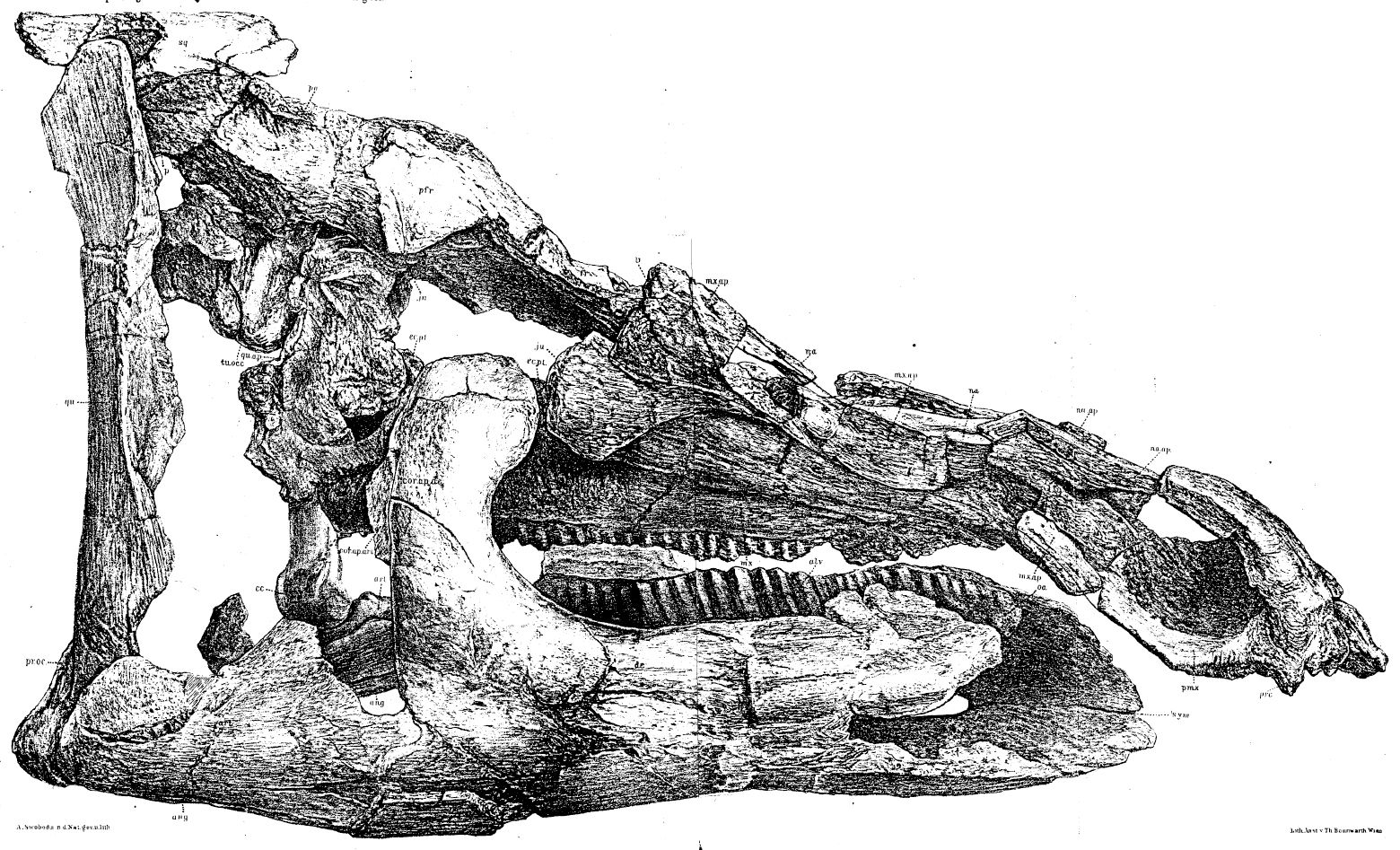
Franz Nopcsa's 1900 plate showing views of the Telmatosaurus skull discovered in the Sânpetru Formation.

Ancestors

House of Dwarf Dinosaurs, Sânpetru · Hațeg Country

Dinosaur Valley — Sânpetru

A community visitor centre, a research story that began near Sânpetru, and rocks preserving an island world far more varied than the phrase ‘dwarf dinosaurs’ suggests.

Image: Franz/Ferenc Nopcsa · Public domain · full 1900 plate preserved, optimised for the web, and displayed with tonal treatment

Quick facts and editorial frame

The place at a glance

Real place
House of Dwarf Dinosaurs, Sânpetru village, Sântămăria-Orlea commune[4][8]
Trace scope
The House and the fossil story around Sânpetru; La Scoaba remains a contextual extension without access directions[1][4]
UNESCO context
Hațeg Country UNESCO Global Geopark, administered by the University of Bucharest[1][2]
House — 15 May–15 September
Tuesday–Saturday 10:00–17:00; Sunday 10:00–14:00; no regular Monday hours are published

The English page publishes 19:00 rather than 17:00. The earlier Romanian time is used pending confirmation.

[4][5]
House — 16 September–14 May
By appointment only; booking lead time and responsible booking party are not published[4][5]
Current full route
10 Km, low difficulty, 200 m elevation difference, asphalt and forest road; not the length of the La Scoaba segment[6][7]
Location
Sânpetru village; approximate House location, with no confirmed entrance or parking[4][30]
Protection
Do not dislodge, collect, or damage a suspected fossil; leave it in place and inform the geopark[3][10][12][13]

Featured legend

Today's Track

A fictional clue hunt about giants, balaurs, and dinosaurs, in which the freshest track proves the hardest to recognise.

The hourglass was smaller than Daria's fist. The guide with the green badge turned it over, and the sand began to run before the last child had finished protesting.

‘Three stops,’ she said. ‘One answer at the end. Whoever finds it wins the explorer badge.’

She showed them a photograph of the prize: a circle of card printed with a three-toed track and attached to a red cord. The real badge was waiting for them at the final box. It was not bone, tooth, or stone, but simply thick card.

Daria wanted that badge. The trouble was, Matei almost always answered before she had time to think, and the sand was already running.

The other children headed towards the first table. The parents stayed back by the door. The rules of the game were simple: no one was to leave the rooms and courtyard indicated by the guide, no one was to touch the exhibits, and the team had to stay together.

A scroll tied with string lay on the table. Matei unrolled it so quickly that he nearly tore it.

In the drawing, a shepherd stood on a riverbank. A bone as thick as a tree trunk rose out of the ground, and beyond the hills loomed the shadow of a giant man.

Under the picture was written:

‘The waters brought them to light. Some of those who found them were afraid to touch them. Whose did they believe they were?’

‘Dinosaur!’ Matei shouted.

‘Too easy,’ said a girl with two plaits. ‘It's a giant's bone.’

Daria imagined a hand as large as the roof of the House. The giant knelt beyond the Sibișel, searching among the stones for a missing finger. He did not look angry. He looked puzzled that people had spoken of him because of some animals' bones.

‘In the story, they belonged to giants,’ Daria said. ‘That doesn't mean “giant” is the answer to the game.’

But the others had already found the next symbol on the back of the scroll: a green wing. They hurried towards the Elopteryx diorama in the next room.

There, beside the diorama, the second envelope was waiting. The girl with two plaits opened it and read:

‘In stories it has scales. In our game it gets feathers. Its name was borrowed for a fossil animal described by scientists. What is it?’

‘A balaur!’ three children said at once.

For a moment, Daria saw one coiled around the roof beams. It had wings that were too small, a thick tail, and blue feathers around its ears. It kept all its heads bowed so that it would fit inside the room and tried to read over the children's shoulders.

Daria blinked. The beams were empty.

‘*Balaur bondoc*,’ Matei said. ‘We've finished.’

‘Not yet,’ the guide replied. ‘That is the second clue.’

She showed them the corner of the envelope. Small muddy tracks had been drawn there, each with three slender points.

The children looked at the floor. There was a real spot of mud near the threshold, then another in the courtyard. The guide had told them they could follow only the white stepping stones between the door and the wooden table beside the fence. The whole team set off that way, with the adults behind them.

The hourglass had stayed inside, but Daria could almost see the sand running.

The tracks passed an overturned bucket, a clump of mint, and three stones painted with eyes. At the end stood a low box. Written on its lid were the words:

‘The final track has three toes. What age is it from?’

Matei lifted the lid. The box was empty, and so was the hook on its side where the badge ought to have been hanging.

‘The age of the dinosaurs,’ he said. ‘We have to write dinosaur.’

The girl with two plaits crouched beside the box without taking her feet off the white stones.

‘Maybe the balaur took the prize.’

The others talked over her. One said Elopteryx. Another said the track was too small. Matei searched for a fourth envelope under the table.

Daria looked at the marks again.

They were not hardened in stone. The mud still glistened, and one of the tracks crossed over a fresh yellow petal. Between the spots, the stones had remained dry. The tracks did not stop at the box. They continued beyond the table.

A red thread was caught on one of the stones.

‘The badge had a red cord,’ Daria said.

For the first time, the others fell silent.

The thread led towards the mint, then to an empty basket. Something rustled behind it. The team advanced along the line of stones, with the adults close by.

A brown hen stepped out of the grass. She was pecking at the end of the red cord. The explorer badge dragged behind her, covered in dust.

The hen looked at the children with one eye, dropped the cord, and took three stately steps towards the fence.

Behind her, she left three more three-toed marks.

‘She stole the prize!’ Matei said.

‘She didn't steal it,’ said the girl with two plaits. ‘She discovered it.’

The guide picked up the badge and dusted it off. Then she glanced towards the door, where the hourglass was letting its final grains of sand fall.

‘At the first two stops, you said “giant” and “balaur”. You said the last track came from the age of the dinosaurs. What does the evidence say?’

Matei was still watching the hen. The girl with two plaits had already begun drawing a head with seven beaks in the corner of the game sheet.

Daria pointed to the still-wet mud, the fresh petal, the strand of cord, and the tracks continuing all the way to the basket.

‘It isn't an old track,’ she said. ‘It's today's track.’

The guide turned the badge over. On the back was a blank space for the winner's name.

Before she could write, the hen came back, stepped across the card, and left a small muddy print in its centre.
Documented folklore

Reported local legends

These stories are traditions or accounts associated with the place, not confirmed historical facts and not the original fiction published by Legends of Romania.

01 · Reported

The Giants' Bones of the Sibișel Valley

An account preserved at Sânpetru says that shepherds knew the unusual bones exposed by water along the Sibișel Valley and regarded them as the remains of giants. Some feared touching them because they were believed to bring misfortune.

Do not turn the account into a claim that giant human skeletons were found, and do not say palaeontology proved that the giants were dinosaurs. Science identifies fossil animals; the giant interpretation documents how unusual bones were understood. The misfortune motif belongs to this version and should not automatically be added to every giants' bones story.

Dan Grigorescu published the account in 2020 from information supplied by his Sânpetru guide, Doenel Vulc, who attributed it to an unnamed village elder who had known and assisted Franz Nopcsa. This is a recorded chain of oral transmission, not a surviving statement by Nopcsa or a nineteenth-century folklore transcript.

[25]

The real place

What is true here

Dinosaur Valley at Sânpetru connects a community interpretation centre with exposures of the Sânpetru Formation along the Sibișel Valley. Here, the research story that began around 1895, the science of a Cretaceous island, and the ways people understood unusual bones can be read together without turning the giants' tradition into fact or reducing the science to one spectacular explanation.

01

Culture

Well documented

A house that opens a trail

The House of Dwarf Dinosaurs is a small visitor centre created at Sânpetru in 2013, with a reconstructed palaeontological dig, a carnivorous-dinosaur skeleton, an Elopteryx diorama, and an education room created by the local children's club.

UNESCO places it at the beginning of the trail towards La Scoaba; indoor hours and outdoor route access must be checked separately. This trace implements only the House as a visitor point; La Scoaba remains context without coordinates or directions until the operator confirms access.

[1][4][9]

02

History

Source-based estimate

Where the research began

In 1895, twelve-year-old Ilona Nopcsa collected fossil bones on the hills near Sânpetru. Her brother Franz continued the research and published in 1897, the same year in which geologist Gyula Halaváts separately reported fossil vertebrates from the area.

The UNESCO trail now leads to La Scoaba, but historical sources do not place Ilona's find at that precise modern point.

[1][14][15]

03

Science

Source-based estimate

The Cretaceous's final chapter

The fossil-bearing beds along the Sibișel Valley belong to the Sânpetru Formation and the Maastrichtian, the final stage of the Cretaceous. Magnetostratigraphy places the studied section approximately within the interval 72–68 million years ago.

The concise phrase ‘about 70 million years ago’ is safer than ‘65 million years ago’.

[16]

04

Science

Well documented

A floodplain of rivers, ponds, and seasons

The rocks preserve evidence of an alluvial plain crossed by braided rivers, with ponds and wetlands beside better-drained ground. Fossil soils indicate a subhumid climate with seasonal variation rather than one permanent swamp.

Dinosaurs shared this environment with crocodilians, turtles, and small mammals.

[17][18][24]

05

Science

Well documented

The bone ‘pockets’ were reinterpreted

Nopcsa interpreted some bone accumulations as crocodilian feeding places. Later sedimentological and taphonomic work indicates that many such fossil ‘pockets’ were concentrated by water after bones were disarticulated, exposed, and transported.

Bite marks occur, but cannot by themselves explain every accumulation.

[19][17]

06

Science

No consensus

Dwarfism was not a rule for every species

Hațeg Island is an important example of island evolution, but not every animal there became dwarfed. Evidence is strong for Magyarosaurus and supported for Telmatosaurus; for Zalmoxes, one histological study did not confirm evolutionary size reduction.

A 2025 sauropod revision shows both small and very large forms in the region, although they did not necessarily all live at the same time. These comparisons concern the wider Hațeg Basin and island fauna; they do not establish that every named taxon or body-size class occurred at the public La Scoaba stop.

[20][21][22][23]

07

Culture

Well documented

The balaur as a modern bridge, not a local legend

The geopark deliberately combines balaur and dragon imagery with dinosaur science in modern interpretation programmes. The scientific name Balaur bondoc uses a Romanian folkloric allusion, but the type specimen comes from Sebeș rather than Sânpetru, while the animal's classification and diet remain debated.

The ‘Balaurs, Dragons, Dinosaurs’ exhibition is in Hațeg, not at the Sânpetru House.

[26][27][28]

At a glance

Reference facts

Experience identity

House of Dwarf Dinosaurs
Small visitor centre created at Sânpetru in 2013[4][9]
Exhibition
Reconstructed palaeontological dig, carnivorous-dinosaur skeleton, Elopteryx diorama, and education room created by the children's club[4][5]
UNESCO sequence
House → La Scoaba → Ohaba-Sibișel; only the House is implemented as a visitor point in this trace[1]
Editorial boundary
La Scoaba receives no coordinates or directions until the operator confirms the route[1][3]

Science and research

Research beginnings
Ilona Nopcsa found fossil bones near Sânpetru in 1895; the precise modern point is not established[14][15]
Sânpetru Formation
Maastrichtian, approximately 72–68 million years ago for the studied section[16]
Environment
Alluvial plain with braided rivers, ponds, wetlands, better-drained ground, and seasonal variation[17][18]
Island dwarfism
Strongly supported for some taxa, not a rule for every animal on Hațeg Island[20][21][23]
Eggs and hatchlings
Famous discoveries at other basin localities, not attributed to the public La Scoaba geosite[14]

Visiting notes

Two checks
House opening and outdoor route condition are separate checks[4][6]
Published House contact
+40 254 777 853; No booking form or lead time is published[4][5]
Facilities
Parking, toilets, accessibility, pushchairs, and payment are not officially confirmed[4][3]
Children
Family-oriented educational experience; supervision and physical accessibility are not detailed[4][9]

Visiting guide

Practical notes

Accessibility
Seasonal House; outdoor route unconfirmedThis trace centres on the House of Dwarf Dinosaurs in Sânpetru village. The map shows an approximate location from a secondary tourism source, rather than a confirmed entrance, parking or trailhead. La Scoaba remains context without access directions until the operator confirms access.
Time & Season
Variable for the House; the full 10 km route is a separate undertaking, with no published walking-only duration · Regular House hours are published from 15 May to 15 September; from 16 September to 14 May, appointment onlyIdeal time: During confirmed House hours; no regular Monday hours are published, and the outdoor route must be checked separately
01

Getting there

The House of Dwarf Dinosaurs is in Sânpetru village, Sântămăria-Orlea commune. The tourism-source pin is for orientation; secondary sources differ, and the exact entrance is not officially confirmed. Use the House page and geopark contact to confirm arrival. No parking, drop-off, accessible-arrival or trailhead point was verified.

02

When to go

For 15 May–15 September, the Romanian page publishes Tuesday–Saturday 10:00–17:00 and Sunday 10:00–14:00; it publishes no regular Monday hours. From 16 September to 14 May, entry is by appointment only. The English page gives 19:00 rather than 17:00, so the earlier Romanian time is used pending confirmation.

03

Is it suitable for children?

Yes. The House is designed as an educational space and includes a room created by the local children's club. Adults should supervise children, explain the difference between fossils and reconstructions, and never encourage touching, dislodging, or collecting geological material.

04

Keep in mind

The House and outdoor route require separate checks. Admission, payment, toilets, pushchair access, accessibility, photography policy, and guide availability are not officially confirmed. Contact the geopark ahead if any of these is essential.

05

About La Scoaba

UNESCO describes La Scoaba as the next trail geosite after the House, but no public arrival point, segment condition, signage, unrestricted access, or guide requirement was confirmed. This page retains it as context and gives no directions.

06

The full Dinosaur Valley route

The complete version in the current table is 10 km, low difficulty, with 200 m elevation difference and a mixture of asphalt and forest road. It continues beyond the House–La Scoaba sequence and should be planned as a separate undertaking. Published estimates combine driving with walking or cycling with walking; do not infer a walking-only time.

07

If you notice a possible fossil

Leave it exactly where it is, do not clean it or dig around it, and do not publish its precise position. Take a photograph only from a safe place without leaving the route, and inform the geopark team. Fossil collection is subject to authorisation, while the geopark prohibits the sale or destruction of fossils and minerals.

Before you go

Safety is part of the journey.

Do not dislodge, collect, or damage a suspected fossil. Do not dig or leave public routes to search for fossils. Leave any possible find in place, avoid publishing its precise position, and inform the geopark team.

Practical information checked 7 September 2026

  • On the day of your visit, check weather, closures, opening information, and local rules in the official resources.
  • Stay on marked, permitted routes. Turn back if markings, weather, or terrain become unclear or unsafe.
  • Avoid going alone and tell someone your route and expected return time.
  • Carry an offline map, charged phone, water, changing-weather layers, and a first-aid kit; mobile coverage is not guaranteed.
  • Keep your distance from wildlife, never feed it, and follow local bear alerts and instructions.

Official resources and updates

In an emergency, call 112 or 0SALVAMONT (+40 725 826 668) and provide your location and the group’s condition.

Field detail

Notice this

At the House, distinguish the reconstructed dig, reconstructed skeleton, diorama, and any labelled specimen. A reconstruction explains evidence but does not automatically become the original fossil or proof that the taxon was found at La Scoaba.

Location

Where it is

The pin shows the attraction location for orientation. It is not automatically a car park, trailhead, or proof of vehicle access.

Documentation

References

Numbers in the text point to the list below. Titles open the external source used for verification.

  1. [1]Haţeg Country UNESCO Global Geopark — UNESCO, International Geoscience and Geoparks Programme
  2. [2]Hațeg Country UNESCO Global Geopark — Universitatea din București
  3. [3]Geoparcul Tara Hategului — Geoparcul Internațional UNESCO Țara Hațegului / Universitatea din București
  4. [4]Casa Dinozaurilor Pitici — Asociația de Turism Retezat
  5. [5]House of Dwarf Dinosaurs — Retezat Tourism Association
  6. [6]Trasee tematice — Țara Hațegului. Istorii vii. / Asociația de Turism Retezat
  7. [7]Traseu tematic Valea Dinozaurilor — Descoperă Eco-România / Asociația de Ecoturism din România
  8. [8]Obiective turistice — Primăria comunei Sântămăria Orlea
  9. [9]DESCOPERĂ APRECIAZĂ RESPECTĂ — Geoparcul Internațional UNESCO Țara Hațegului / Universitatea din București
  10. [10]Lege nr. 5 din 6 martie 2000 privind aprobarea Planului de amenajare a teritoriului național — Secțiunea a III-a — zone protejate — Parlamentul României / Portal Legislativ
  11. [11]Hotărâre nr. 2.151 din 30 noiembrie 2004 privind instituirea regimului de arie naturală protejată pentru noi zone — Guvernul României / Portal Legislativ
  12. [12]Ordonanță de urgență nr. 57 din 20 iunie 2007 privind regimul ariilor naturale protejate, conservarea habitatelor naturale, a florei și faunei sălbatice — Guvernul României / Portal Legislativ
  13. [13]Ordin nr. 410 din 11 aprilie 2008 pentru aprobarea Procedurii de autorizare a activităților de recoltare, capturare și/sau achiziție și/sau comercializare, pe teritoriul național sau la export, a florilor de mină, a fosilelor de plante și fosilelor de animale vertebrate și nevertebrate, precum și a plantelor și animalelor din flora și, respectiv, fauna sălbatice și a importului acestora — Ministerul Mediului și Dezvoltării Durabile / Portal Legislativ
  14. [14]The Latest Cretaceous fauna with dinosaurs and mammals from the Haţeg Basin — A historical overview — Palaeogeography, Palaeoclimatology, Palaeoecology 293 / Elsevier
  15. [15]Franz Baron Nopcsa: A short life of research in dinosaur evolutionary paleobiology and Albanology — The Anatomical Record 306(7) / Wiley / American Association for Anatomy
  16. [16]Palaeomagnetism of the Upper Cretaceous Sânpetru Formation (Haţeg Basin, South Carpathians) — Palaeogeography, Palaeoclimatology, Palaeoecology 293 / Elsevier
  17. [17]Depositional environments and fluvial system changes in the dinosaur-bearing Sânpetru Formation (Late Cretaceous, Romania): Post-orogenic sedimentation in an active extensional basin — Sedimentary Geology 192 / Elsevier
  18. [18]Palaeoenvironmental reconstruction of the Late Cretaceous Sânpetru Formation (Haţeg Basin, Romania) using paleosols and implications for the “disappearance” of dinosaurs — Palaeogeography, Palaeoclimatology, Palaeoecology 272 / Elsevier
  19. [19]Taphonomic modes in the Maastrichtian continental deposits of the Haţeg Basin, Romania—Palaeoecological and palaeobiological inferences — Palaeogeography, Palaeoclimatology, Palaeoecology 293 / Elsevier
  20. [20]Dinosaurs and the island rule: The dwarfed dinosaurs from Haţeg Island — Palaeogeography, Palaeoclimatology, Palaeoecology 293 / Elsevier
  21. [21]Small body size and extreme cortical bone remodeling indicate phyletic dwarfism in Magyarosaurus dacus (Sauropoda: Titanosauria) — Proceedings of the National Academy of Sciences / National Academy of Sciences
  22. [22]Phylogeny, Histology and Inferred Body Size Evolution in a New Rhabdodontid Dinosaur from the Late Cretaceous of Hungary — PLOS ONE 7(9) / Public Library of Science
  23. [23]Revision of Romanian sauropod dinosaurs reveals high titanosaur diversity and body-size disparity on the latest Cretaceous Haţeg Island, with implications for titanosaurian biogeography — Journal of Systematic Palaeontology 23(1) / Taylor & Francis
  24. [24]Spatial and Temporal Distribution of the Island-Dwelling Kogaionidae (Mammalia, Multituberculata) in the Uppermost Cretaceous of Transylvania (Western Romania) — Bulletin of the American Museum of Natural History 456(1) / American Museum of Natural History
  25. [25]From Scientific Research to Geoconservation and Geopark — Geoconservation Research 3(2) / OICC Press
  26. [26]Space and Time Perception and the Geopark's Communities. From Mythical Geography to Heritage Interpretation — International Review of Social Research 6(2) / De Gruyter Open
  27. [27]An aberrant island-dwelling theropod dinosaur from the Late Cretaceous of Romania — Proceedings of the National Academy of Sciences 107(35) / National Academy of Sciences
  28. [28]The phylogenetic affinities of the bizarre Late Cretaceous Romanian theropod Balaur bondoc (Dinosauria, Maniraptora): dromaeosaurid or flightless bird? — PeerJ 3:e1032 / PeerJ
  29. [29]House of Dwarf Dinosaurs — Outdooractive
  30. [30]Casa dinozaurilor pitici — Pensiunea RetezatCoordinate from a secondary tourism source; approximate location, rather than an officially confirmed entrance or parking point.