Skip to content
LEGENDS
OF ROMANIA
RO
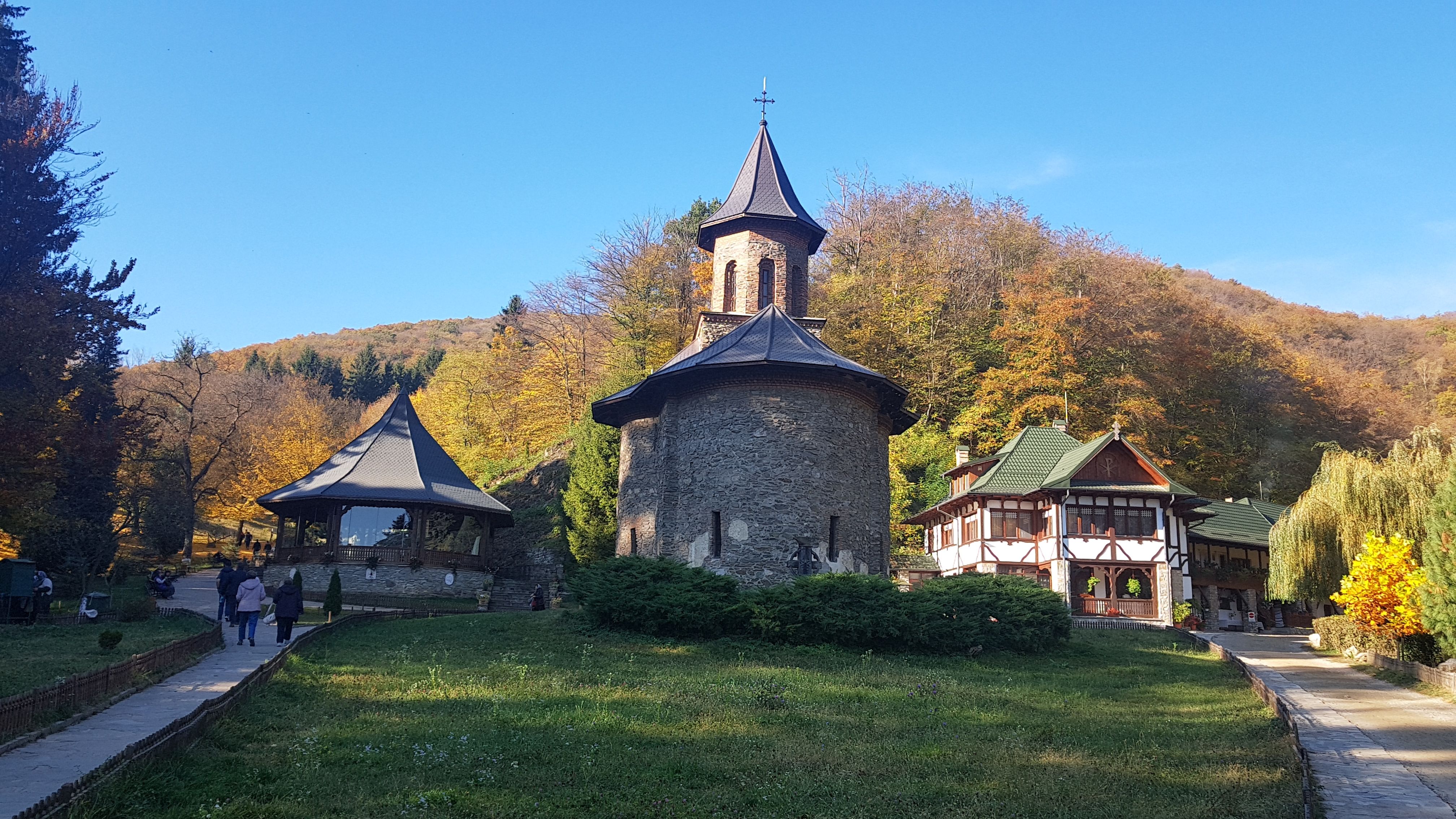
The stone church of Prislop Monastery, with its tower and monastic buildings against woodland, photographed in 2019.

Faith

Prislop Monastery · Silvașu de Sus · Hațeg Country

Prislop Monastery

A medieval church, a manuscript and pilgrimage within a living monastic community in Hațeg Country.

Photo: Leontin l · CC BY-SA 4.0 · photograph from 21 October 2019, cropped and optimised for the web; does not confirm current access conditions

Quick facts and editorial frame

The place at a glance

Real place
Silvașu de Sus, Hațeg, Hunedoara; not Prislop in Maramureș[10]
Beginnings
First phase: fourteenth–fifteenth centuries; exact year not established[1]
Rebuilding
1564, Zamfira[3]
Heritage records
RAN 87610.01; LMI HD-II-m-A-03447[1]
Community
Convent within the Diocese of Deva and Hunedoara[11][10]
Before travelling
Monastery contact: 0756 083 435; confirm visiting arrangements[10]

Featured legend

Who Calls First

Two siblings come to Prislop with the same question and different things to say.

I — Ana

I brought the house documents in a folder with an elastic fastening, although there was nobody at Prislop who would ask us for them. I put them in my bag on top of the water bottle. At every bend I could feel the folder’s corner against my knee and thought about how I would start the conversation on the way back.

Radu was driving. He had only told me on Thursday evening that he could come, after I had asked twice. That morning he had waited outside my block of flats with the engine running and two coffees. Mine had milk in it. I had stopped taking milk a few years ago, but I said nothing.

Mum had died in February. Since then, Dad had been sleeping in the same room and heating up too much food. The house had four rooms, a stove that needed rebuilding and a roof for which Radu had sent me three quotes. I wanted us to sell and find Dad a flat near me. Radu had written in the group chat: ‘We can’t decide everything in a week.’ Seven months had passed.

At Prislop I hoped to understand what I ought to do. I had not prepared a question to put to anyone. I wanted to pray without my phone beside my elbow, as it was at home, and leave able to choose.

Near the church, Radu asked whether he should wait for me.

‘I don’t know how long I’ll be.’

‘I didn’t ask how long.’

I lifted the bag onto my shoulder. The folder’s elastic had caught on the lining. While I freed it, he stayed beside me with his hands in his pockets.

‘You can come,’ I said.

II — Radu

I bought two coffees because that was what I used to do when I went on trips with my parents. Only when I saw the untouched cup did I remember that Ana no longer took milk. We had not seen each other since the memorial service, but we had spoken almost every day about one thing or another that needed paying for.

I had taken the day off. I did not tell her how much negotiating it had taken; she would have started counting all the days she had missed work. I knew about them. There was still a photograph on my phone of the sheet she had stuck to the fridge: medicines, times, numbers. I had received the photograph; she had lived beside the sheet.

I did not expect anything to happen to me at Prislop. I had come because she had asked, and because we would have to sit in the car together without being able to end the conversation with ‘we’ll talk later’. Even so, all we had discussed on the way was a lorry, coffee and where I had left a pair of glasses.

Ana was looking at the stone church. I took out my phone, saw a quote for roofing sheets on the screen and put it away. The tower rose above the roof; I did not know which side Mum had entered from when she came here. I should have asked her then.

‘Have you eaten anything?’ I asked Ana.

She shook her head. I had two sandwiches wrapped in paper in my rucksack. I told her I would keep them for later.

An older man was trying to fasten a bag, gripping it between his knees. He asked me to hold it for a moment. I took the handles, he stuffed a waistcoat inside, then pulled the zip all the way shut. When he thanked me, Ana had turned towards us.

‘Are you staying here?’ she asked.

‘I am.’

She went to find somewhere she could pray. I held her bag. I could see the folder of documents through the opening.

III — Ana

While I stood apart, things I needed to do kept coming to mind: ring the builder, buy Dad a bathroom light bulb, find a box for the crockery nobody used any more. I had begun my prayer three times, and each time I ended up at the same house.

I had become angry with Radu before I said anything to him. In my mind, he had come with a day off and two sandwiches, while I had come with the past few years. Then I remembered that I had not even asked him what was in his rucksack. Whatever he brought already seemed too little to me.

Mum had once phoned me from here, long before she became ill. She had not told me anything unusual. She had said she would be late home and asked me to check whether Dad had taken the bread out of the freezer. I had been annoyed: I was at work and she was ringing about bread. Now I remembered how hurried my answer had been.

When I returned, Radu was holding the bag with both hands to stop it slipping. I took it and got out the water bottle. He unwrapped a sandwich and gave it to me with the paper folded back at one end.

‘Even if we do the roof,’ I began, ‘it won’t sort out the rest.’

‘I know.’

‘And I can’t keep going round every evening.’

‘I never said you should.’

‘But I do.’

He stood with the empty paper in his hand. I wanted to add something about quotes and how easy it was to send a file. Instead, I asked him:

‘What did Dad tell you he wants?’

Radu looked at me.

‘About the house?’

I nodded.

‘That we’ll talk when you come too.’

He had told me we would talk when Radu came. I opened the bag to put the water away. The folder was there. I left it inside.

IV — Radu

Ana asked for my sandwich paper and folded it together with hers. She had done that since she was little: cleared away what was left before everyone else had finished. I told her to leave the bag with me until we went.

‘I still think we need to sell,’ she said.

I had not expected her to change her mind. Nor was I convinced that a flat was the answer. Dad spent a good part of the day in the yard. In a block of flats he would have to learn even where to sit when he wanted to be alone.

‘I don’t want us to decide today,’ I told her.

‘When, then?’

I took out my phone. I was busy the following Sunday, but I could rearrange Saturday. I checked the calendar and showed her the day.

‘We’ll both go. I’ll stay until Monday. You can come back whenever you need to.’

Ana read what I had written against Saturday, then asked whether I had spoken to Dad.

‘I’ll ring him this evening.’

She began to say something and stopped. I could hear myself saying the very words I usually ended our conversations with. I looked at the screen again.

‘I’ll ring him now.’

‘Don’t ask him about the documents straight away,’ she said.

I wanted to tell her I knew that much. Instead, I found his number. Ana stayed beside me. I did not know whether she had found what she had come to Prislop to look for. She had eaten the sandwich, and she had not put the folder in my arms.

Nobody answered the first call. I waited a little and rang again. When I heard the connection, Ana moved close enough to listen.

‘Dad?’
Documented folklore

Reported local legends

These stories are traditions or accounts associated with the place, not confirmed historical facts and not the original fiction published by Legends of Romania.

01 · Traditional

Saint Nicodim’s foundation

According to the church tradition reported by Basilica, Nicodim of Tismana is associated with Prislop’s foundation around the transition from the fourteenth to the fifteenth century. This remains an attribution to tradition; it does not prove that he built the whole present church.

The sources do not establish one certain foundation year. Nicodim’s manuscript colophon names the Hungarian realm, rather than Prislop; the later attribution is not a foundation document.

Published church tradition, distinct from the construction phases described in the archaeological register.

[3][1][2]

02 · Traditional

Saint Ioan’s cell

The hagiographic account published by Basilica after Mircea Păcurariu relates that Ioan withdrew to a cell cut into rock and was accidentally killed by hunters. The text connects this tradition with Hieromonk Efrem’s eighteenth-century verse chronicle.

Păcurariu suggests the fifteenth or early sixteenth century; RAN mentions the seventeenth. No exact date is fixed, and he is not conflated with Abbot Ioan, who became metropolitan in 1585.

A published account of an older tradition, rather than an eyewitness record. The historical description of the cell does not confirm a current visitor route.

[12][1]

The real place

What is true here

Prislop’s history unfolds in stages: the medieval church and its rebuilding, the manuscript associated with Nicodim, the Greek-Catholic period and today’s Orthodox community. Traditions about the foundation and cell are presented separately.

01

History

Source-based estimate

Medieval beginnings without a certain year

The archaeological register places the church’s first phase in the fourteenth–fifteenth centuries. Tradition associates its foundation with Nicodim of Tismana; this does not establish a precise, certain year for the surviving building.

[1][3]

02

History

Well documented

Zamfira and the rebuilding of 1564

The church was rebuilt in 1564 by Zamfira, daughter of the Wallachian ruler Moise Vodă. This documented phase should be distinguished from traditions about the monastery’s earlier beginnings.

[3]

03

Science

Well documented

Reading the church through its building phases

The archaeological record describes the 1564 phase with a triconch plan and a tower above the nave. These are architectural features of the church; they do not mean that every visible wall and intervention is the same age.

[1]

04

Unexpected fact

Source-based estimate

A manuscript known by another monastery’s name

Nicodim’s Tetraevangelion of 1404–1405 is also known as the Tismana Tetraevangelion. MNIR associates it with his stay at Prislop, qualifying that attribution in its 2011 account. The manuscript belongs to the museum’s collection; it is not promised as an exhibit at the monastery.

[4][5]

05

History

Well documented

Greek-Catholic Prislop and 1918

Ionuț Vida-Simiti’s study documents the Greek-Catholic monastery and Abbot Leon Iulian Manu’s role in the Romanian National Council at Hațeg in 1918. The heritage register records its transfer to Orthodox administration in 1948. The site’s confessional history has several stages.

[6][1]

06

History

Well documented

Arsenie Boca and twentieth-century Prislop

The diocese associates the reorganisation of monastic life in 1948–1959 with Arsenie Boca. After his death in 1989, he was buried at Prislop, and his grave became a pilgrimage destination. These biographical points are distinct from accounts of spiritual help or miracles.

[7]

07

Culture

Well documented

The decision and the local proclamation

The Holy Synod decided on Arsenie Boca’s canonisation in July 2024, under his church title Arsenie of Prislop. The local proclamation took place here on 28 November 2025. These are stages of an ecclesiastical act, rather than medical verification of reported miracles.

[8][9]

08

Culture

Well documented

A living monastic community

In January 2024, the diocese recorded Abbess Veniamina Lazăr’s installation in the presence of the nuns and sisters. The diocesan directory confirms the monastery at Silvașu de Sus. A visit takes place within an active religious community, rather than a museum without liturgical life.

[11][10]

At a glance

Reference facts

Historical reference points

Manuscript
1404–1405; Nicodim’s Tetraevangelion, in the MNIR collection[4][5]
Local proclamation
28 November 2025, canonisation of Arsenie of Prislop[9]

Visiting guide

Practical notes

Accessibility
Confirm hours and access with the monasteryAn active monastery at Silvașu de Sus. Routine hours, parking and a step-free route are not confirmed. Access to the church, grave and cell needs separate confirmation.
Time & Season
Variable; no confirmed visiting or waiting time · After confirming current arrangements with the monasteryIdeal time: According to the hours supplied by the monastery
01

Getting there

Identify Prislop Monastery at Silvașu de Sus, Hațeg, Hunedoara County, rather than the monastery of the same name near Borșa. Ask the monastery for the current arrival point and parking arrangements. The map locates the church approximately; it does not confirm an entrance, car park or step-free access.

02

When to go

When checked on 30 October 2026, the diocesan directory listed 0756 083 435 but no routine visiting hours, fees or booking policy. Confirm these details before travelling, including on feast days. Special arrangements for the November 2025 event are not a timetable for a visit today.

03

Is it suitable for children?

Prepare children for a visit to an active religious community and supervise them. Ask about waiting times, toilets and pushchair access. The church, grave and cell are not confirmed to share the same access conditions.

04

Keep in mind

As a matter of courtesy, dress respectfully, keep your voice low and follow displayed rules or staff guidance. Ask permission before photographing people, services or interiors. This editorial guidance does not replace the monastery’s current rules, which need confirmation.

05

Facilities and accessibility

Parking, toilets, drinking water, step-free routes and the assistance-animal policy are not confirmed. Explain your group’s particular needs to the monastery before setting out. The 2019 photograph and map point do not confirm current conditions.

Before you go

Safety is part of the journey.

Respect services, the community’s privacy and guidance on site. Do not assume the route to the cell is open or suitable for your whole group.

Practical information checked 30 October 2026

  • On the day of your visit, check opening information, closures, and rules in the official resources.
  • Use only areas open to visitors and respect barriers, signs, and instructions from staff or the community responsible for the place.
  • Take care on steps and uneven or slippery surfaces, and supervise children.
  • Keep your phone charged and adapt the visit to the weather and the conditions you find on arrival.

Official resources and updates

In an emergency, call 112 and describe the location and situation as clearly as possible.

Field detail

The church’s stone and its building phases

If visiting arrangements allow, observe the apse and tower shown in the historical photograph from a permitted place. The archaeological record describes different building phases; a stone’s appearance alone does not establish its age.

Location

Where it is

The pin shows the attraction location for orientation. It is not automatically a car park, trailhead, or proof of vehicle access.

Exploration

Nearby traces

Documentation

References

Numbers in the text point to the list below. Titles open the external source used for verification.

  1. [1]Situl bisericii Sf. Treime a Mănăstirii Prislop de la Silivaşu de Sus — Institutul Național al Patrimoniului, Repertoriul Arheologic NaționalRecord updated in 2020, with approximate localisation. Historical data does not confirm current condition or access.
  2. [2]Mănăstirea Prislop — INP / CIMEC, Lăcașuri de cult din RomâniaThe summary dating and old diocesan affiliation are not adopted as current information; uncertainties around the foundation are retained.
  3. [3]Mănăstirea Prislop în haine de sărbătoare — Basilica, Patriarhia Română
  4. [4]Debutul seriei de evenimente "Exponatul lunii" — Muzeul Național de Istorie a României, 2011Temporary exhibition announcement from 2011; the Prislop attribution is qualified. It does not confirm present display.
  5. [5]Un ev mediu religios. Teme iconografice creștine regăsite pe obiecte de cult — Muzeul Național de Istorie a RomânieiObject 131507. The catalogue attribution is read alongside the qualified wording from 2011.
  6. [6]Participarea călugărilor basilieni la Marea Adunare Naţională de la 1 Decembrie 1918 — Ionuţ Vida-Simiti; Satu Mare – Studii și Comunicări XXXIV/II (2018), pp. 185–195Study in Satu Mare – Studii și Comunicări XXXIV/II (2018), pp. 185–195; Leon Iulian Manu’s role and the Greek-Catholic period.
  7. [7]Episcopia Devei și Hunedoarei va avea o nouă distincție eparhială – Ordinul „Cuviosul Arsenie Boca de la Prislop” — Episcopia Devei și HunedoareiBiographical details from an article preceding canonisation. For current church status, see the 2025 sources.
  8. [8]Sinteza activităților Bisericii Ortodoxe Române în anul 2024 (text integral) — Patriarhia Română; Basilica
  9. [9]Proclamarea locală a canonizării Sfântului Cuvios Mărturisitor Arsenie de la Prislop — Episcopia Devei și HunedoareiChurch event completed on 28 November 2025. Devotional language about miracles remains attributed belief.
  10. [10]Mănăstiri și schituri — Episcopia Devei și HunedoareiPublic monastery contact: 0756 083 435. The directory publishes neither routine visiting hours nor an accessibility assessment.
  11. [11]Obștea Mănăstirii Prislop are o nouă stareță — Episcopia Devei și Hunedoarei
  12. [12]Sfântul Ioan de la Prislop — Basilica; Mircea Păcurariu, Sfinți Daco-Romani și RomâniHagiographic account after Mircea Păcurariu, referring to Efrem’s chronicle; not an eyewitness record or a guide to reaching the cell.
  13. [13]File:Mănăstirea Prislop (1).JPG — Wikimedia Commons; Razvan SocolCommunity metadata: object location 45.631699, 22.850315, distinct from camera position. Secondary orientation evidence, not an entrance or parking location.